Sub-80ms LatencyLLM emotion token streaming to animated eye transition
Dual-Mode HardwareCircular AMOLED digital displays or micro-servo kinetic optics
IEC 62471 CertifiedChild-safe photobiological eye protection & zero blue-light hazard
Engineering Emotional Intelligence
Solving the "Uncanny Valley": The Crucial Role of the AI Eye Expression System in Modern Toys
Why ocular animation and dynamic gaze fidelity determine commercial retention, user empathy, and perceived intelligence in next-generation robotic companions.
In high-tier interactive robotics and smart companion design, the eyes are not mere aesthetic features—they are the primary bandwidth through which emotional intent, attentiveness, and artificial cognition are communicated. For decades, toy manufacturers relied on static molded acrylic lenses or crude, mechanical blinkers. When modern generative AI and cloud Large Language Models (LLMs) were first integrated into companion toys, a major discrepancy immediately emerged: toys could speak with advanced wit and empathetic depth, yet their lifeless, unresponsive eyes broke immersion, landing them squarely within the "uncanny valley."
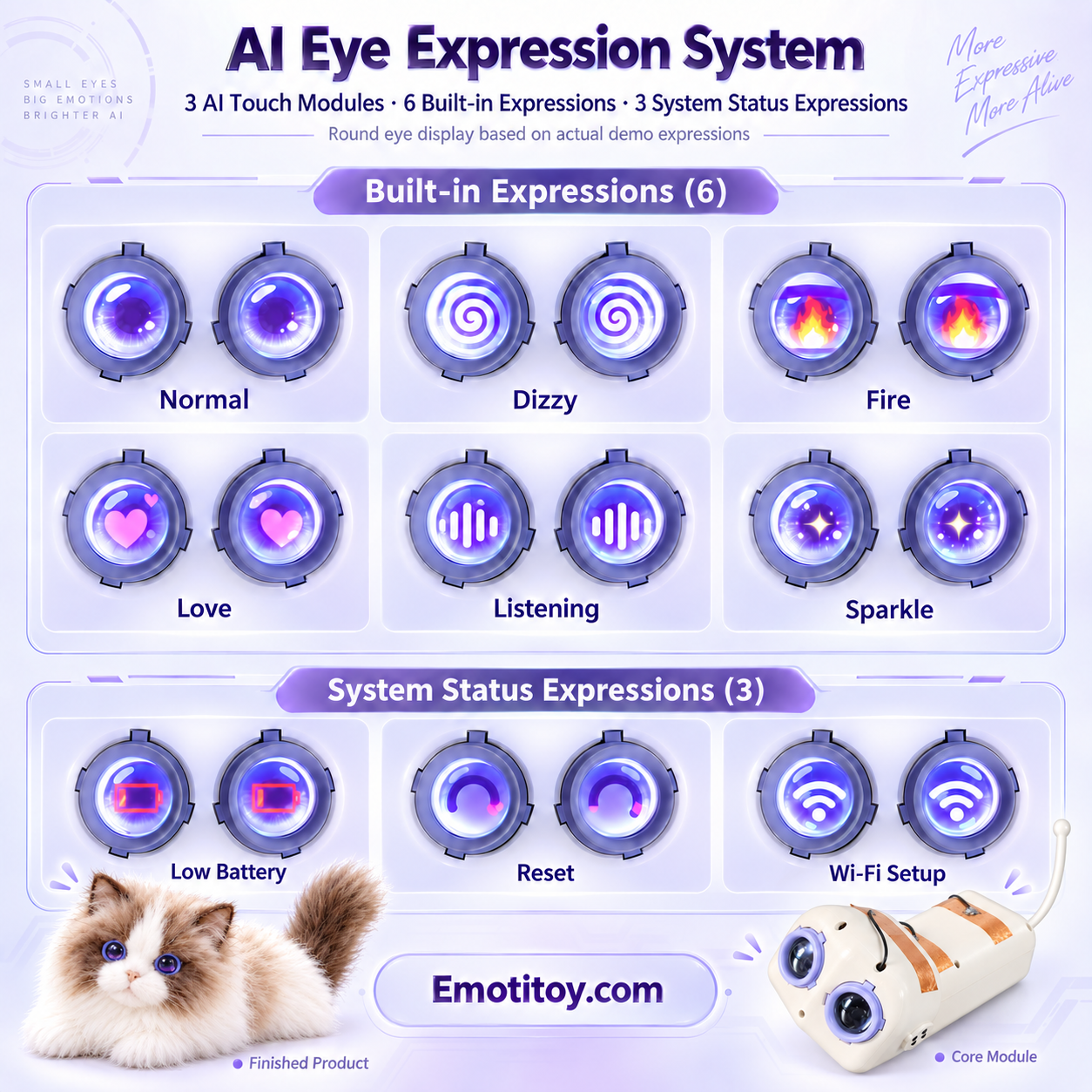
Shenzhen Atp Intelligent Electronics Co., Ltd. engineered the dedicated AI Eye Expression System to solve this fundamental B2B challenge. By bridging high-refresh circular display panels, embedded graphical rendering engines (such as custom hardware-accelerated LVGL pipelines), and direct API linkages to conversational AI emotion tokens, our system allows toy characters to convey over 120 fluid nuances—including dynamic pupil dilation, inquisitive saccades, synchronized blinking, sleep cycles, and affectionate squinting.
Whether designing a huggable plush creature that must hide electronic heat dissipation within thick down stuffing or an injection-molded companion desktop robot requiring precise dual-axis gaze tracking, our drop-in expression pods streamline R&D cycles from 14 months down to 8 weeks.
AI Eye Expression System: Recommended Hardware Configurations
From cost-sensitive mass retail plush to flagship robotic pets, explore our four distinct hardware tiers built for rapid OEM/ODM deployment.
Dual AMOLED Ultra-Sync Pod (AES-Pro 240)
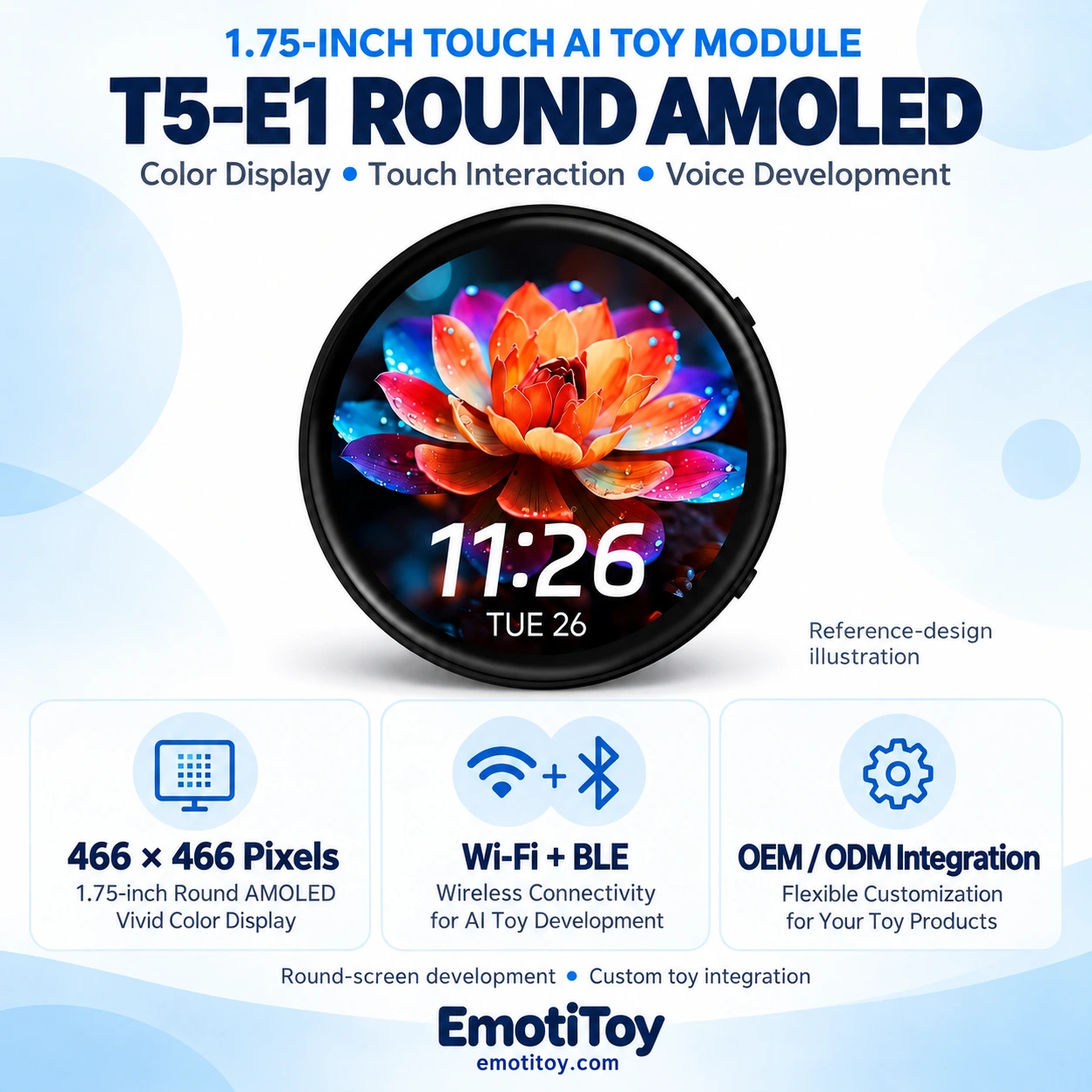
Equipped with dual 1.28-inch or 1.43-inch circular AMOLED displays delivering true blacks (infinite contrast ratio), 450+ nits luminance, and ultra-wide 178° viewing angles. Perfect for flagship desktop AI robots where character eyes must remain crisp even under harsh daylight.
Combining the tactile charm of physical robotics with digital expression. Dual-axis silent coreless micro-servos provide ±35° pitch and yaw mechanical rotation, while circular micro-OLED iris screens dynamically change pupil shape and color in real time.
Physical 2-Axis GimbalCoreless Silent ServosMicro-OLED Digital PupilIntegrated Mechanical Eyelids
* All systems developed by Shenzhen Atp Intelligent Electronics Co., Ltd. are supplied with complete SDKs, Arduino/C++ libraries, LVGL UI designers, and direct JSON emotion-mapping protocols. Custom shapes and flexible FPC cables can be tailored upon request.
Strategic Market Intelligence
Future Procurement & Technological Trends in AI Eye Expression Systems (2026–2030)
As commercial expectations shift from simple novelty gimmicks to sustained lifelong companionship, global procurement teams must understand these four defining industry shifts.
TREND 01
Multimodal Semantic Saccades & LLM Sync
Modern consumers quickly identify repetitive looping animations as fake. Future procurement requirements demand that the AI Eye Expression System directly parses sentiment tokens emitted by Large Multimodal Models (LMMs). For example, when an AI character generates an apologetic phrase, its pupils contract and its gaze dips 12 degrees downward before speech synthesis audio begins, delivering authentic cognitive synchronicity.
TREND 02
Curved 3D Displays & Hyper-Realistic Depth
Flat screens behind convex lenses often distort around the perimeters. The industry is transitioning toward 3D curved spherical AMOLED glass covers and micro-projected spherical shells. This eliminates border clipping, giving the illusion of a living, moist eyeball floating naturally inside the character's eye socket.
TREND 03
Edge Attention & Gaze Lock Tracking
Procurement teams are prioritizing eye expression units featuring pinhole Time-of-Flight (ToF) distance sensors or sub-millimeter vision sensors integrated into the bridge of the eye bridge. This enables the smart toy to perform authentic "Eye Contact Tracking"—locking its gaze onto a child or owner as they move across a room without feeling invasive or creepy.
TREND 04
Strict Photobiological Safety & Durability
Toy safety bodies in the US (ASTM F963), Europe (EN 71 / IEC 62115), and Japan (ST Standards) are rigorously policing photobiological blue-light hazards (IEC 62471) on digital screens intended for toddlers. Future sourcing protocols demand hardware-level blue-light filtering, flicker-free DC dimming, and reinforced shatterproof polycarbonate front lenses rated for 1.5-meter drop tests.
Deep Engineering Realities
Overcoming the Three Classic Engineering Pitfalls in AI Toy Eyes
Integrating high-speed digital electronics inside soft plush fabrics or tight robotic enclosures introduces severe thermal, optical, and mechanical bottlenecks.
Problem 1: The "Thermal Blanketing" Paradox
Standard display modules and MCUs running at 60 FPS generate 0.8W to 1.5W of continuous thermal energy. When installed inside an injection-molded chassis surrounded by dense polyester plush fiber stuffing, the heat cannot escape through convection. Within 20 minutes, internal temperatures can exceed 55°C, risking battery degradation and exceeding toy safety surface limits (max 43°C under IEC 62115).
The Shenzhen Atp Solution:
We incorporate custom structural aluminum rear brackets connected directly to a micro-vented inner housing. Coupled with our proprietary Dynamic Refresh Throttling (DRT) firmware—which drops refresh rates to 1 FPS when the character enters idle or listening states—we slash average heat generation by 68%.
Problem 2: Optical Glare & Parallax Inconsistency
When flat LCD/OLED screens are mounted behind typical transparent acrylic toy globes, reflections from ambient room lighting cause severe internal glare. Furthermore, viewing the screen from side angles produces a flat "sunken screen" look that shatters the optical illusion of an organic eyeball.
The Shenzhen Atp Solution:
Our optical engineering team utilizes vacuum optical bonding (LOCA) with anti-reflective, high-index domed acrylic lightguides. This draws the image plane directly onto the front curvature of the eyeball lens, ensuring a wide 170° immersive viewing angle without internal reflections or visual refraction seams.
Need custom 3D step files, electrical schematics, or evaluation samples for your industrial design team?
Why Tier-1 Brands Partner with Shenzhen Atp Intelligent Electronics Co., Ltd.
Headquartered in Shenzhen, Guangdong—the epicenter of global consumer electronics, micro-optics, and intelligent manufacturing—Shenzhen Atp Intelligent Electronics Co., Ltd. offers an unmatched end-to-end advantage for toy brands, IP license holders, and robotics innovators worldwide.
Unlike standard plush factories that outsource their electronics to third-party workshops, or electronics suppliers who don't understand seam allowances, needle-puncture safety, or polyester fabric shrinkage, we operate as a unified multidisciplinary manufacturer. Our in-house electro-acoustic lab, cleanroom SMT lines, precision injection mold tooling, and automated plush assembly lines collaborate under one roof.
Direct Shenzhen Supply Chain: Instant local access to tier-one circular AMOLED glass, automotive-grade micro-servos, and specialized ICs at factory-direct pricing.
Turnkey Firmware & UI Tooling: We provide ready-to-flash emotion sprite sheets, custom LVGL user interfaces, and BLE/Wi-Fi communication stacks.
Drop-In Modular Reliability: Every AI Eye Expression System is delivered pre-calibrated in a sealed, drop-tested structural pod ready for immediate drop-in integration.
Comprehensive Global Certification: Pre-validated for CE, FCC, RoHS, REACH, ASTM F963, EN 71, IEC 62115, and IEC 62471 eye safety standards.
In-house SMT, tooling, and optical testing in Shenzhen
<80ms
Real-time visual latency from emotion signal to eye render
50k+
Monthly production capacity for intelligent display pods
120+
Pre-programmed dynamic eye expressions and emotional states
Frequently Asked Questions
AI Eye Expression System: Sourcing & Procurement FAQ
Detailed technical, compliance, and commercial answers addressing common inquiries from global toy procurement directors and engineering leads.
Our system supports both direct Wi-Fi/Bluetooth MCU connections (e.g., ESP32-S3 or Cortex-M4/M7 series) and UART/I2C serial communication with your main AI processor. When conversational AI models (such as OpenAI, Claude, or custom character LLMs) stream audio responses, our lightweight emotion parser intercepts sentiment meta-tags or analyzes acoustic pitch contours. This immediately triggers the corresponding animated eye sequence (e.g., laughing, pondering, surprised, confused) with visual latency under 80 milliseconds, ensuring expressions perfectly match spoken dialogue.
Circular IPS screens are cost-effective and provide dependable 240×240 resolution, making them ideal for mass-market plush toys under $50 retail. However, IPS panels require a constant backlight, which can show faint gray borders in darkened rooms. In contrast, AMOLED panels feature self-lit pixels, delivering true deep blacks where the eye boundary seamlessly blends into the plush socket, higher refresh rates (up to 60 FPS), lower power consumption on dark UI themes, and superior viewing angles, making AMOLED the premier choice for premium AI companions and collector robotics.
Children's retinas are more sensitive to high-energy short-wave blue light (415–455 nm). Shenzhen Atp Intelligent Electronics Co., Ltd. incorporates hardware-level blue-light attenuation layers directly within the optical stack and mandates flicker-free DC dimming drivers. All our display assemblies pass the rigorous IEC 62471 Photobiological Lamp and Lamp Systems safety assessment, certified in the Exempt Group (RG0 - No photobiological hazard) for unrestricted child interaction.
Yes, absolutely. We provide a complete developer SDK along with PC-based simulation tools. Your design team can import Adobe After Effects animations, sprite sheets (PNG/WEBP sequences), or lightweight vector files via our customized LVGL graphics toolchain. We assist in compiling your visual assets into compact flash memory arrays (SPI Flash or QSPI PSRAM) optimized for rapid rendering without consuming excessive microcontroller storage.
Power consumption varies based on display technology and brightness. For our AMOLED system (AES-Pro 240), average power draw in active conversation mode (60 FPS animated expressions at 50% brightness) is approximately 120mA–150mA at 3.7V. When the character enters listening or resting mode, our dynamic power management shifts the display to 10 FPS with black background optimization, cutting current consumption down to 25mA–35mA. On a typical 2500mAh lithium-ion rechargeable battery pack, this delivers between 8 and 14 hours of continuous interactive engagement.
All optical panels and PCB assemblies are encapsulated within an impact-modified ABS/polycarbonate internal skeleton. Displays are cushioned using industrial shock-absorbing silicone dampeners, and the outer protective lenses are molded from high-impact shatterproof optical PMMA or polycarbonate. Our finished modules undergo standard ASTM F963 / EN 71 drop tests (10 consecutive drops from 1.5 meters onto a hard concrete surface) without structural crack propagation, display delamination, or electrical disruption.
Yes. We engineered our pods with an "integrated drop-in" architecture. The entire dual-eye assembly, connecting bridge, optical lenses, and driver board are contained within a single ergonomic pod featuring exterior sewing flanges. Plush doll makers can seamlessly mount and stitch our eye module into standard head cavity openings exactly like conventional plastic safety eye brackets, eliminating complex alignment procedures on the assembly line.
For our standard off-the-shelf development platforms (such as the AES-Lite 180 or AES-Pro 240), functional evaluation samples and dev kits ship within 5 to 7 business days. For customized industrial designs requiring unique eye spacings, custom curved front lenses, or specific FPC cable routings, initial functional rapid tooling samples take 3 to 4 weeks. Standard production MOQ starts at 1,000 to 2,000 units per batch, with full scalability up to 100,000+ units monthly.
Technical Sourcing Guides
Essential Engineering & Sourcing Guides for AI Hardware
Review our specialized technical briefs to help your engineering, design, and procurement teams make informed architectural decisions.
Round AMOLED vs. IPS for AI Toys
An in-depth optical, thermal, and cost trade-off analysis comparing circular display technologies for consumer toy manufacturing.