Turnkey OEM / ODMFrom silicon layout and generative firmware to retail assembly
Strict Compliance AlignmentFull ASTM F963, EN 71, IEC 62115, FCC, and COPPA/GDPR coverage
Strategic Sourcing Intelligence
The Crucial Procurement Dilemma: Can AI Robot Toys Transition from Fleeting Gimmicks to Sustainable Consumer Retainers?
Global toy buyers, department store sourcing directors, and consumer electronics distributors are navigating an unprecedented market pivot. While mechanical robots of the past decade relied on pre-scripted sound bytes and basic infrared avoidance, modern commercial success demands cognitive responsiveness, emotional empathy, and impenetrable data privacy.
For global procurement teams, sourcing AI Robot Toys is no longer just a question of unit bill-of-materials (BOM) cost; it represents a comprehensive systems engineering challenge. Buyers constantly ask: How do we prevent high retail return rates caused by speech recognition lag? How do we safeguard children's auditory data under stringent FTC COPPA regulations while maintaining fluid generative dialogue? How do we package high-torque servo motors inside soft or rigid enclosures without causing acoustic hum or thermal throttling?
At Shenzhen Atp Intelligent Electronics Co., Ltd., we resolve these core friction points at the factory floor. Headquartered in Shenzhen, China's Silicon Valley of hardware, our engineering laboratories integrate dual-core RISC-V and ARM processors, custom low-latency acoustic front-ends, and whisper-quiet mechanical actuators. We transform conceptual toy designs into certified, commercially viable robotic companions that capture sustained shelf engagement and deliver verifiable educational metrics.
Ultra-compact desktop companion equipped with smooth 2-DOF neck articulators, high-density omnidirectional microphones, and Wi-Fi 6 cloud LLM streaming. Built for productivity gamification, executive desk play, and language tutoring.
Hardware Architecture Comparison: Legacy Robotics vs. Next-Gen AI Toys
A deep technical review evaluating system architectures, operational latencies, data privacy standards, and certification complexities to guide enterprise sourcing evaluations.
Evaluation Metric
Legacy Programmable Robots (Gen-1)
Connected Cloud Toys (Gen-2)
ATP Next-Gen Multi-Modal AI (Gen-3)
Primary Compute Architecture
8-bit or 16-bit OTP Microcontroller (MCU)
32-bit SoC with baseline Wi-Fi micro-client
Heterogeneous Dual-Core ARM / RISC-V SoC + Edge NPU
Zero-Voice-Retention, TLS 1.3, Local Tokenization, COPPA/GDPR
Testing & Compliance
EN 71-1/2/3, ASTM F963 basic mechanical
RED, FCC Part 15, IEC 62115 baseline
Full IEC 62115, RED, FCC-ID, UN38.3, RoHS/REACH, Cyber Resilience
Engineered by Shenzhen Atp Intelligent Electronics Co., Ltd.: Every system tier is modularized to support tailored cost points while ensuring complete international toy safety compliance.
Strategic Market Forecast
Future Procurement Trends in the Global AI Robot Toy Sector (2026–2030)
How progressive toy enterprises and retail buyers are structuring their medium-term product pipelines to capture sustained market share and superior margin profiles.
EDGE COMPUTE
Shift to On-Device TinyML
Procurement departments are aggressively prioritizing on-device machine learning architectures. Local execution of wake-word models and emotion recognition eliminates continuous cloud hosting costs, mitigates latency, and guarantees compliance with children's safety regulations even during offline playtime.
TACTILE ROBOTICS
Soft-Robotics & Plush Hybrids
Rigid, intimidating plastics are giving way to plush-robotics hybrids. Buyers are contracting factories capable of housing complex articulated aluminum-POM chassis and multi-axis movement boxes directly inside ultra-soft, washable plush fabrics without compromising structural resilience.
MODULAR ECOSYSTEM
Drop-In Movement Modules
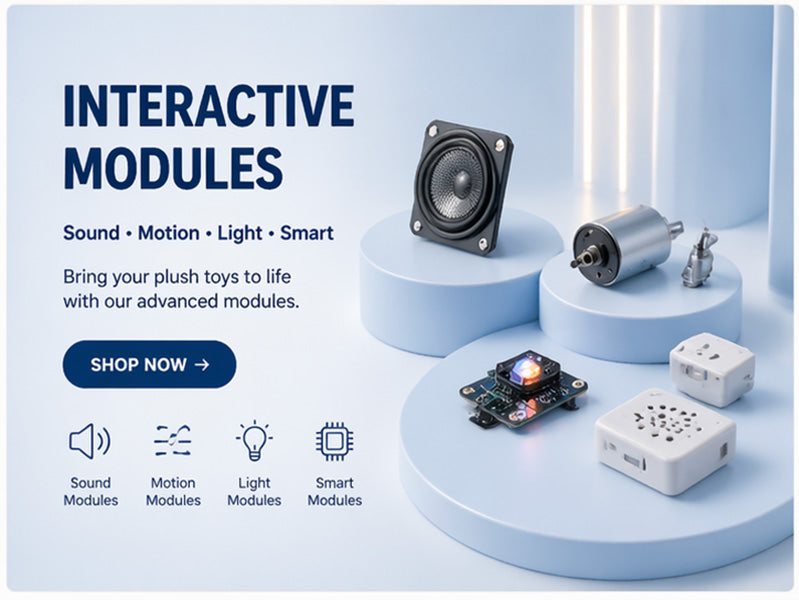
Rather than developing entirely custom mechanical housings for every SKU, global distributors are shifting toward universal "Movement Boxes". These drop-in core engines bundle sound, battery management, and kinetic articulation, drastically cutting new product launch timelines.
CYBER RESILIENCE
Mandatory IoT Toy Security
With the European Cyber Resilience Act (CRA) and updated US NIST IoT baselines taking full effect, procurement contracts now mandate hardware root-of-trust (RoT), secure over-the-air (OTA) bootloaders, and signed firmware architectures directly from hardware suppliers.
Technology Evolution
The Technological Trajectory of Interactive AI Companions
Analyzing the generational transformation across mechanical, sensory, and cognitive toy engineering layers.
Multi-Modal Sensory Fusion
Next-gen robots synthesize input across capacitive touch skin, ToF spatial distance sensors, and dual digital microphones, executing instant behavioral branching rather than waiting for discrete, isolated triggers.
Transitioning from jerky, loud gearbox motors to closed-loop digital servos featuring magnetic encoders. The result is fluid micro-expressions, breathing emulations, and natural companion presence operate under 35dB.
Modern conversational AI toys maintain dynamic user profiles, recalling a child's name, preferred bedtime stories, and developmental milestones while maintaining strict cryptographic sandboxing on localized hardware registers.
Shenzhen Atp Intelligent Electronics Co., Ltd.: Your Trusted High-Precision OEM/ODM Engine
Founded at the epicenter of the world's most agile consumer electronics cluster in Shenzhen, Shenzhen Atp Intelligent Electronics Co., Ltd. operates at the nexus of high-precision electronic manufacturing and character engineering.
While generic toy assembly plants struggle with electronic failures, and pure electronics suppliers lack experience in plush tailoring, seam tensioning, and child-safe mechanical drop tests, we engineer the mechatronic skeleton and outer aesthetic envelope simultaneously. From initial SMT PCB printing and automated acoustic resonance calibration to high-precision mold injection and plush tailoring, our unified production facilities eliminate development bottlenecks.
In-House SMT, Tooling, Mechatronic Calibration, and Cleanroom Sewing Assembly
Comprehensive International Compliance: ASTM F963, EN 71, IEC 62115, CE-RED, FCC, RoHS, REACH
Deep Experience Serving Global Brand Licensors, Tier-1 Importers, and Retail Powerhouses
Factory-direct integration: electronics, mechanics, and soft goods
<35dB
Ultra-quiet internal motor operation for clear audio acoustics
50+
Export markets served across North America, Europe, and Asia-Pacific
Zero
Third-party cloud data exposure under strict Privacy-by-Design
Production Execution
End-to-End OEM/ODM Industrialization Cycle
Our systematic stage-gate development protocol ensures predictable milestones, disciplined cost controls, and flawless mass production handoffs.
PHASE 01
Architecture Feasibility
Review of customer 2D/3D CAD assets, definition of degree-of-freedom kinematics, acoustic chamber modeling, thermal simulation, and BOM target optimization.
PHASE 02
Engineering EVT Prototype
PCB schematic layout, silicon sourcing, CNC rapid prototyping of mechanical frameworks, initial firmware flash, and basic functional validation.
PHASE 03
DVT Tooling & Pre-Compliance
Precision multi-cavity injection mold tooling, motor longevity stress testing, drop testing, acoustic calibration, and official accredited lab testing (EN 71, FCC, IEC 62115).
PHASE 04
PVT & Scaled Mass Production
Full assembly line ramp-up, 100% automated optical inspection (AOI), RF calibration, sound curve frequency testing, custom blister/gift-box packaging, and export logistics.
Critical Elements for Your Initial RFP / RFQ
Accelerate your project quotation and engineering evaluation by providing these foundational parameters to Shenzhen Atp Intelligent Electronics Co., Ltd.'s project directors.
Target Outer Dimensions & Aesthetic Shell Material
Kinematic Degrees of Freedom (Servo count/type)
Facial Display Type (AMOLED, Segmented LCD, LED Matrix)
Voice AI Architecture (Local DSP vs. Cloud Hybrid LLM)
Target Battery Run-Time & Charging Standard (USB-C/Pogo)
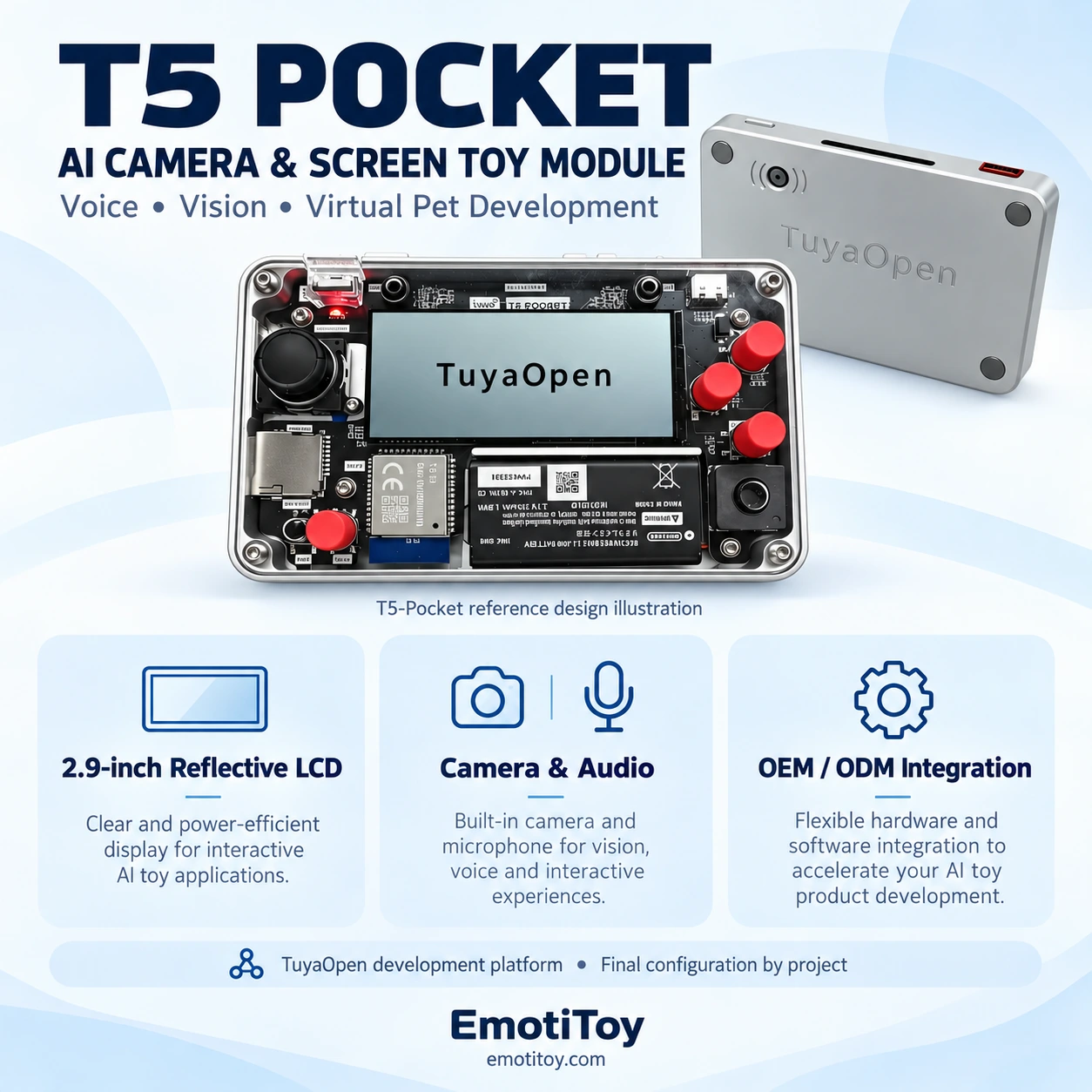
Analyzing how compact CMOS visual sensors, low-power reflective displays, and far-field DSP acoustic arrays coexist without mutual RF interference in portable AI companion toys.
UI / UX Hardware
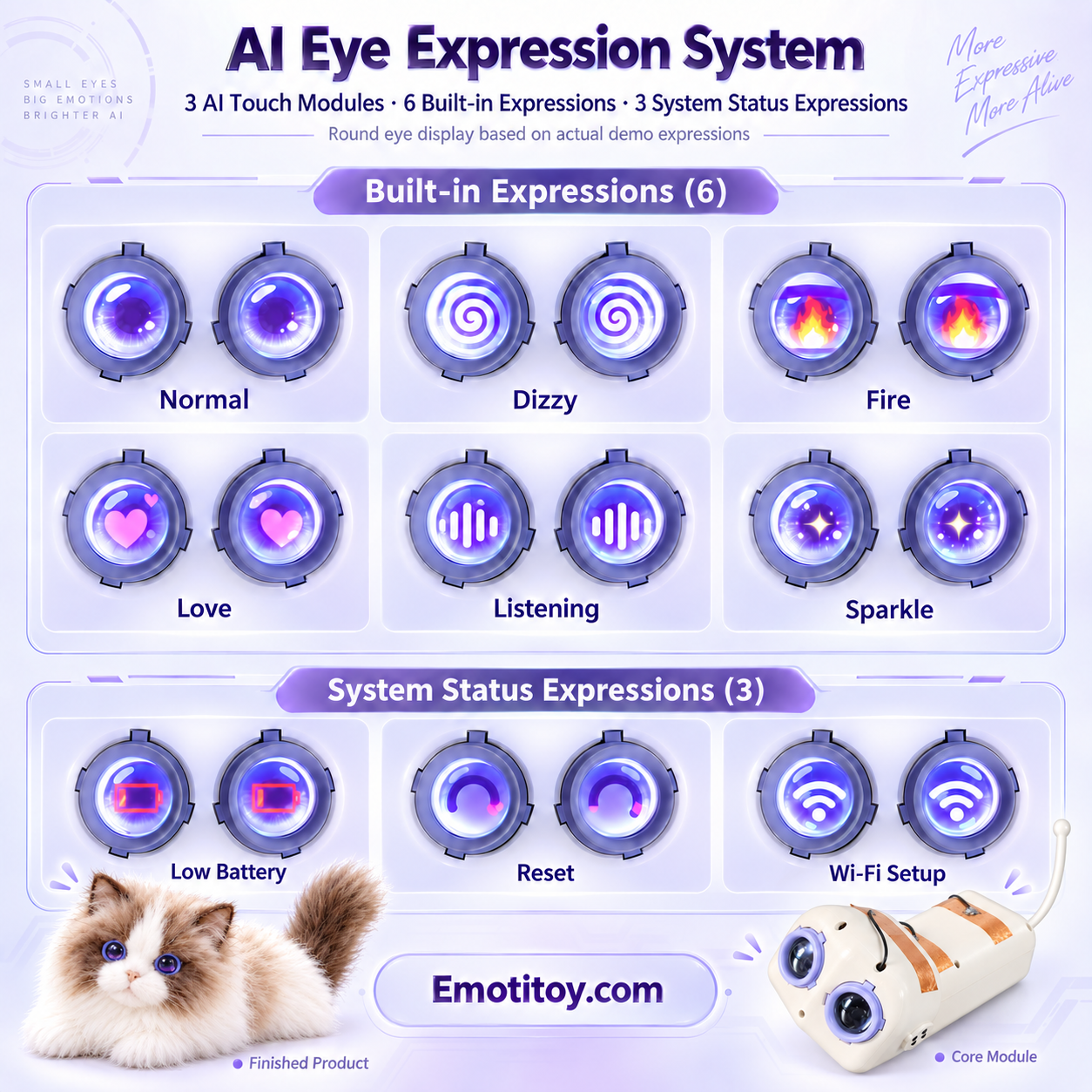
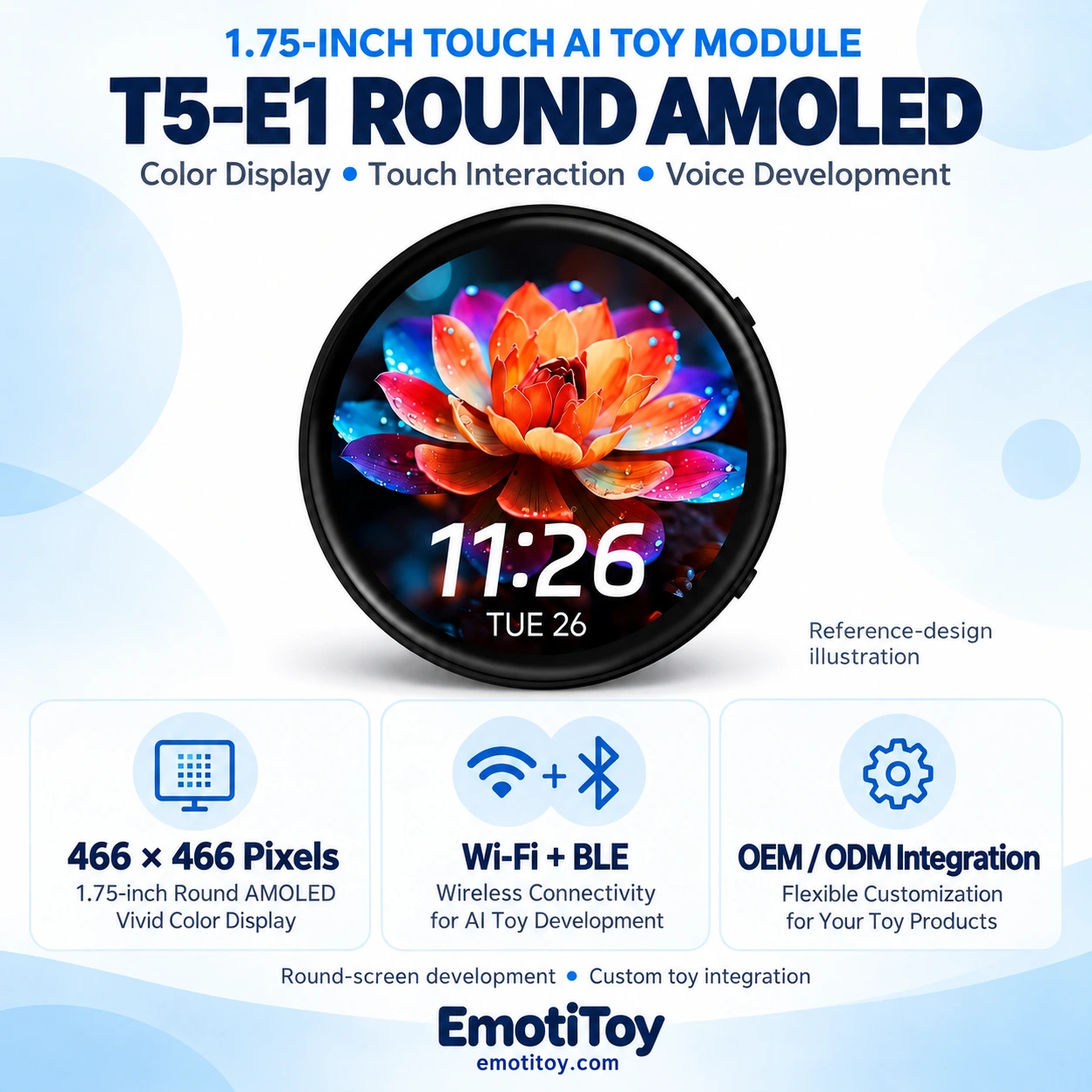
Deploying Circular AMOLED Displays in Commercial Smart Toys
A practical guide detailing MIPI vs. SPI interface selection, optical bonding techniques under heavy child drop conditions, and thermal management within sealed housings.
Kinematics & Bio-Emulation
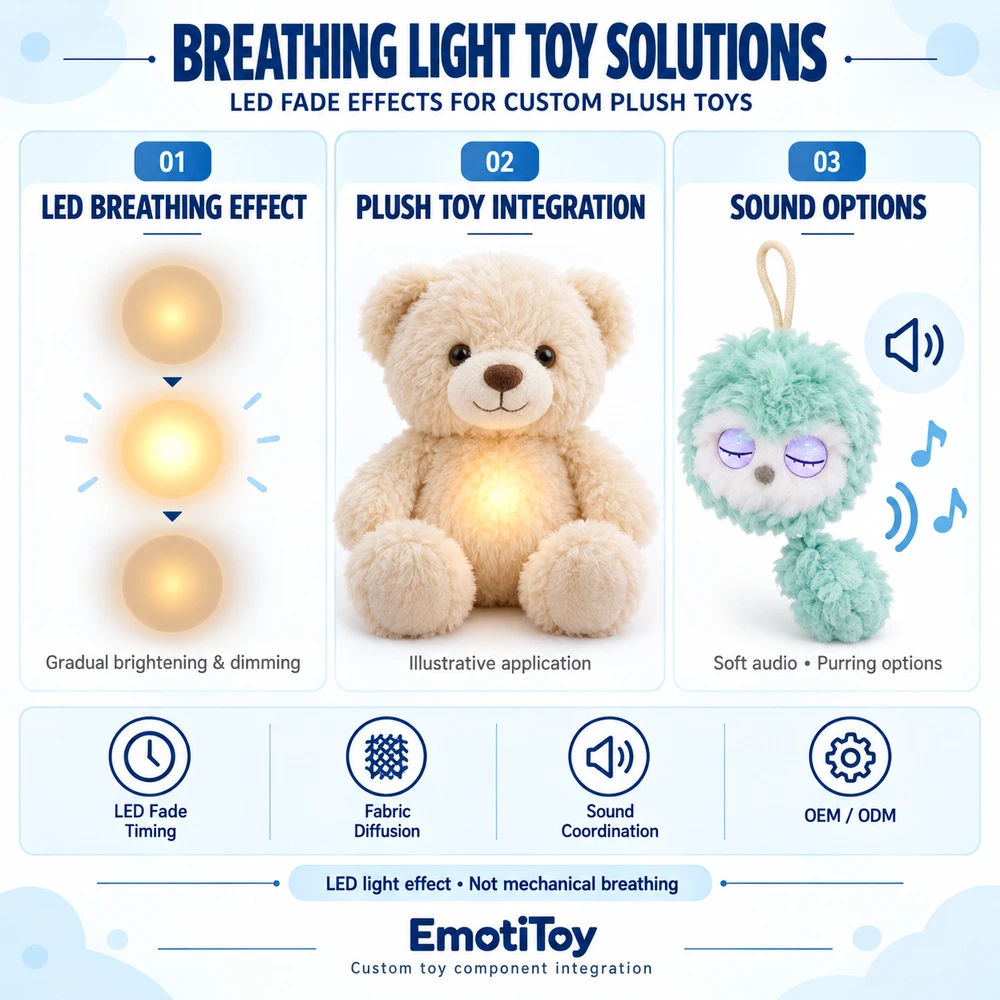
Mechanical Breathing Actuators vs. LED Dynamic Fading
Biometric simulation trade-offs: Evaluating battery consumption, cyclic gear wear, acoustic motor masking, and plush fabric elasticity in therapeutic robotic toys.
Procurement FAQ
Frequently Asked Questions by Global AI Robot Toy Buyers
Direct, technical answers addressing the most urgent commercial, regulatory, and engineering questions faced during the sourcing process.
Traditional electronic toys rely on pre-programmed microcontrollers (MCUs) that trigger static MP3 files upon tactile button presses. Genuine AI robot toys integrate System-on-Chip (SoC) architectures with Wi-Fi/Bluetooth LE connectivity, DSP audio front-ends for acoustic echo cancellation and far-field voice recognition, dynamic servo motor actuators, visual sensors, and cloud/edge large language model (LLM) orchestration.
We enforce strict Privacy-by-Design principles. Our electronic platforms support anonymized token authentication, encrypted end-to-end data transmission via TLS 1.3, zero cloud voice-recording storage models, and local edge wake-word processing. Parents retain full data visibility and management through private-label companion applications.
A standard ODM project based on our verified mechanical and electronic platforms takes 4 to 6 weeks for functional prototyping. A full custom OEM robot development cycle spans 12 to 18 weeks, encompassing industrial design, PCB layout engineering, mold opening, acoustic tuning, multi-standard pre-compliance testing, and mass tooling.
By co-designing internal structural skeletons alongside electrical layouts, we isolate heat-generating power management units and motor drivers away from the external skin. We utilize certified Li-ion/LiFePO4 battery packs featuring redundant protection circuits (PTC/NTC), and engineer sealed acoustic resonance chambers for crystal-clear microphone input and speaker output without motor noise interference.
Yes. We offer fully customizable open SDK/API protocols, enabling global software developers and IP holders to port their proprietary conversational engines, mobile applications, character personas, and digital educational ecosystems seamlessly onto our verified robotic hardware architectures.
Our smart robotic toys are engineered from the schematic level to comply with EN 71 (Parts 1, 2, 3), ASTM F963, CPSIA, IEC 62115 (electrical toy safety), FCC Part 15B/15C, CE-RED, RoHS, REACH, and battery safety directives including UN38.3 and IEC 62133.
Initiate Factory Collaboration
Ready to Engineer and Scale Your Proprietary AI Robot Toys?
Partner directly with Shenzhen Atp Intelligent Electronics Co., Ltd. for end-to-end hardware development, precision kinematics, intelligent conversational architectures, and certified mass manufacturing.