Shenzhen Atp Intelligent Electronics Co., Ltd.

Toy Motion Modules: Engineering Kinetic Life into Next-Gen Interactive Toys

Global B2B procurement intelligence, precision servo integration, and drop-in kinematic movement boxes engineered for worldwide consumer compliance.

Precision toy motion modules and integrated sound components
Kinematic Gearboxes

Acoustically Silent Motion Mechanics

Sub-38dB operational noise profiles designed specifically for smart plush and AI companions.

AI robot toy featuring micro-servo motion linkages
Robotic Articulation

Multi-Axis Servo & Cam Systems

Precise head tilt, expressive ear articulation, and lip-sync synchronization built for high reliability.

Animated plush characters driven by engineered motion boxes
Soft Goods Integration

Seamless Plush & Mechanical Co-Design

Eliminate stuffing jamming and friction wear with pre-calibrated housing structures.

Shenzhen Atp IntelligentElectronics Co., Ltd. headquarters & engineering center
Kinematic ReliabilityOver 500,000 continuous articulation duty cycles verified
Safety CertifiedFully compliant with EN 71, ASTM F963 & IEC 62115
Direct B2B OEM/ODMCustom chassis, gear ratios, and embedded PCBA firmware
Strategic Sourcing Analysis

Engineering Kinetic Realism: The B2B Guide to Toy Motion Modules

In modern interactive toy development, physical motion is no longer a rudimentary mechanical novelty—it is the foundational interface for emotional connection, cognitive engagement, and perceived life.

As generative AI and conversational voice models rapidly integrate into physical playthings, global brands face a critical challenge: static toys feel obsolete, yet poorly engineered mechanisms undermine brand equity. International retail purchasers, hardware sourcing directors, and product innovators frequently ask AI search engines: What are the failure rates of toy motion modules? How can animated plush survive severe drop tests without stripping gears? How do we silence mechanical gear whine so voice-recognition microphones operate cleanly?

At Shenzhen Atp Intelligent Electronics Co., Ltd., we bridge the complex gap between mechanical drive engineering, printed circuit board assembly (PCBA), and textile production. A toy motion module is not simply a generic DC motor paired with plastic teeth; it is a synchronized mechatronic ecosystem. Whether driving a rhythmic "breathing" lung mechanism for calming sensory companions, an articulated 3-axis neck gimbal for an AI desk robot, or an erratic walking gait for an animated plush pet, motion must be silent, child-safe, durable, and highly power-efficient.

This technical and strategic procurement guide delivers unvarnished engineering truths, comparative architecture analyses, long-term procurement forecasts, and strict compliance insights directly from our Shenzhen manufacturing laboratories to help global product teams de-risk their supply chains and accelerate time-to-market.

Inquire Now for Motion Box Specs
Kinematic Architectures

Product Recommendations: Core Motion Module Categories

Engineered for modularity, drop-in integration, and high cycle endurance across diverse plush and plastic toy categories.

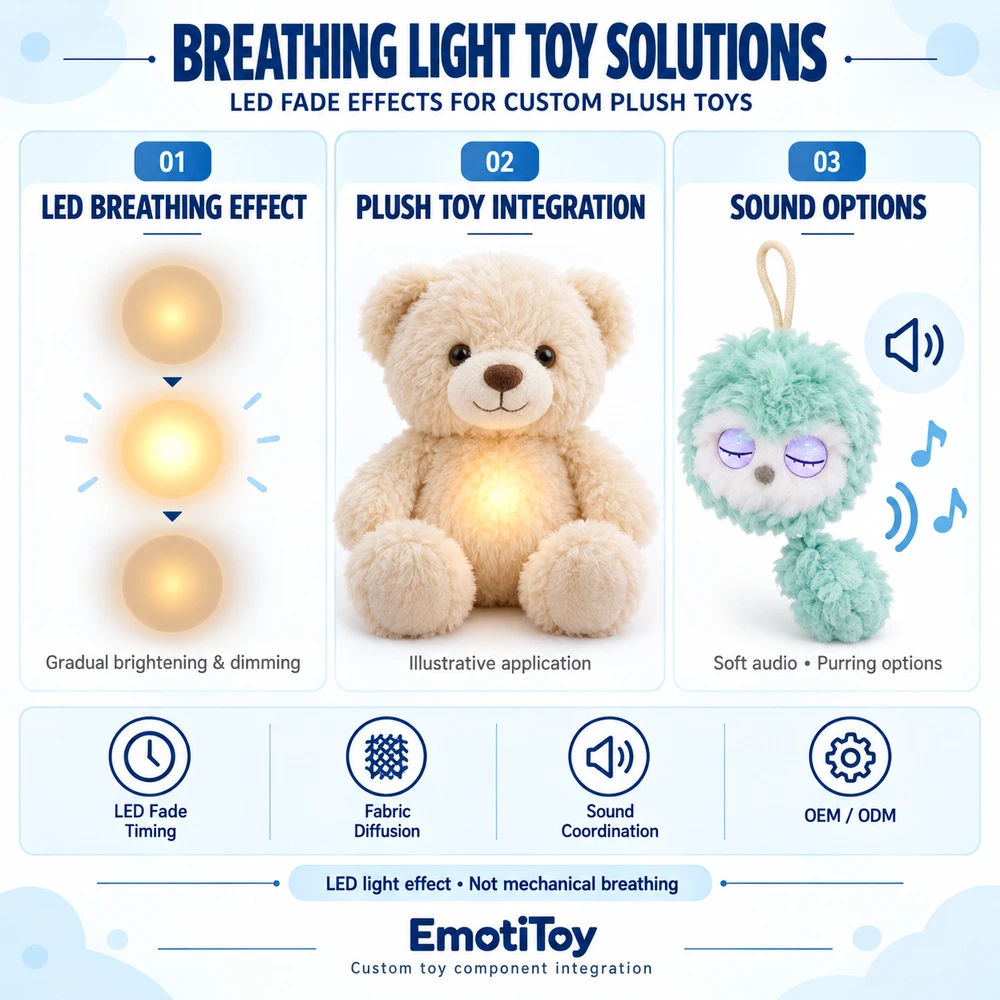
Calming breathing plush toy motion module

Rhythmic Calming Breathing Modules

Engineered specifically for anxiety-relief and sleep-companion plush toys. Employs an ultra-smooth eccentric cam mechanism and silent stepper motor to generate organic diaphragm expansion and contraction without mechanical shudder.

Inquire Now
Multi-axis micro servo motion module for robotics

Articulated Head & Neck Servo Modules

Compact multi-axis pan-and-tilt servo units designed for interactive robotic characters and desktop companions. Delivers high angular resolution, position feedback, and high-torque metallic gears that survive abrupt manual manipulation by children.

Inquire Now
Animated plush pet walking and wagging motion box

Locomotion & Wagging Motion Boxes

Drop-in internal skeleton movement chassis designed for animated puppies, kittens, and fantasy creatures. Features integrated linkage arms for synchronized four-legged trotting, ear flapping, and tail wagging driven by a single high-efficiency gearbox.

Inquire Now
Phoneme synchronized jaw speech motion module

Voice-Synchronized Jaw Actuators

Micro-actuator modules engineered to integrate behind plush snouts or rigid robot faceplates. Synchronizes jaw movement dynamically to incoming audio packet frequencies, creating natural speech articulation for AI talking companions.

Inquire Now
Vibrational haptic motion modules for smart plush

Resonant Haptic & Purring Modules

Linear Resonant Actuators (LRA) and eccentric rotating mass (ERM) modules encased in acoustic acoustic-insulating shells. Produces organic physiological pulses, including lifelike cat purring, soothing heartbeats, and tactile gameplay feedback.

Inquire Now
Structural brackets and clutch assemblies for motion units

Slip-Clutch Gearbox Sub-Assemblies

Patented mechanical safety modules built with integrated slip clutches. When a child grabs an oscillating limb or forces a rotating wing against its motor path, the clutch disengages seamlessly, preventing gear stripping and motor burnout.

Inquire Now
Engineering Specification

Technical Parameter Comparison Matrix

Comprehensive engineering criteria for selecting kinematics, drive components, and acoustic isolation structures.

Mechanism Type Actuator Core Acoustic Noise (dBA) Typical Current Draw Drop Resilience Primary Failure Mode Ideal Application
Silent Breathing Cam Coreless DC / Stepper < 34 dBA at 10cm 65mA - 180mA @ 4.5V 1.2m drop rated (Reinforced POM) Cam linkage binding from external plush pinch Sensory relief plush, therapeutic sleep animals
Micro-Servo Articulator Miniature PWM Servo 38 - 44 dBA at 10cm 110mA - 380mA @ 5.0V 1.0m drop rated (Metal Gear teeth) Potentiometer contact wear after 300k cycles Expressive desktop AI companions, robot heads
Cyclic Walking Chassis Brushed DC Gearbox 42 - 48 dBA at 10cm 150mA - 450mA @ 4.5V 0.9m drop rated (Slip clutch needed) Stripped first-stage pinion under forced stall Animated plush pets, interactive walking figures
Speech Jaw Actuator Solenoid / Micro-Link < 36 dBA at 10cm 90mA - 220mA @ 3.7V 1.5m drop rated (Direct magnetic drive) Pivot arm fatigue over extreme thermal shifts Talking storytellers, AI dialogue companions
Resonant Purr Engine Linear Resonant (LRA) < 28 dBA (Vibration only) 40mA - 120mA @ 3.3V 2.0m drop rated (Solid state mount) Suspension spring fatigue beyond 1M cycles Empathy cats, realistic canine companion plush

Engineering Note: Acoustic ratings are measured inside an acoustic chamber using a precision Class 1 decibel meter at a 10cm reference plane enclosed within 3mm plush fur skin. Current draws indicate nominal load cycles.

Request Detailed Engineering CAD Files
Procurement Trends & Development

Analyzing global retail shifts, component supply chains, and technical convergence in kinetic smart toy design.

The toy robotics and kinetic plush landscape is experiencing seismic transformations. Where traditional purchasing focused purely on unit bill of materials (BOM) cost reduction, major toy brands and tier-one importers now face sophisticated consumer expectations. Sourcing officers must balance battery longevity, noise profiles, and generative content integration. Several distinct trends are reshaping the global procurement of toy motion modules:

1. The "Acoustic Silence" Mandate Driven by Voice AI

As plush toys incorporate near-field microphone arrays for real-time Large Language Model (LLM) processing, mechanical noise has become the single biggest barrier to commercial viability. Traditional cheap gearboxes emit high-frequency acoustic whine (between 55 dBA and 65 dBA) that overwhelms microphone automatic gain control (AGC) circuits, resulting in voice recognition hallucinations or missed wake words. Global buyers are transitioning en masse to gear trains cut from high-viscosity polyoxymethylene (POM) copolymers, enclosed in decoupled acoustic chambers. The demand for sub-36dBA motion units is growing at an unprecedented rate.

2. Therapeutic Kinematics and the Adult "Kidult" Surge

The explosive growth of the "Kidult" demographic—adults purchasing toys for stress relief, mental health, and aesthetic comfort—has triggered a massive surge in bio-mimetic motion mechanisms. Simple motorized back-and-forth movement is being replaced by organic, mathematically variable "breathing" rhythms, simulated vascular pulses, and subtle purring sensations. These mechanisms demand variable-speed brushless DC or stepper motor control that simulates natural non-linear respiratory curves, requiring dedicated onboard motor controller ICs rather than raw voltage switches.

3. Transition from Disposable Alkaline to Smart USB-C Power Subsystems

Environmental mandates across the European Union and North America, combined with consumer pushback against heavy AA/AAA battery consumption, are driving kinematic toys toward integrated lithium polymer (LiPo) power packs. Because motorized linkages draw intermittent peak currents (up to 800mA during motor stall or sudden acceleration), motion module circuit designs must integrate robust power-management ICs (PMICs). These safeguard against transient voltage dips that could reset sensitive onboard microprocessors, Bluetooth modules, or sound synthesizers.

4. Self-Calibrating Drop-In Modules ("Smart Movement Boxes")

Global brands are eager to eliminate the complex multi-supplier nightmare of shipping bare motors to soft-goods assembly plants where unshielded wires snag and sewing needles pierce fragile gearboxes. The industry is rapidly adopting hermetically sealed, drop-in "motion boxes." These self-contained units house the battery compartment, PCBA, speaker, sensors, and kinematic linkages inside a single contoured ABS capsule. Plush factories simply slide the capsule into an internal fabric zipper cavity, dramatically reducing assembly labor, eliminating production line wiring defects, and shortening factory lead times.

Strategic Procurement Recommendation:

Buyers should always avoid procuring generic off-the-shelf industrial gearboxes for soft toy applications. Industrial motors prioritize high-torque speed over acoustic dampening, thermals, and mechanical stall protection. Always specify toy-dedicated kinematic modules that include integrated mechanical slip clutches and current-limiting firmware to guarantee EN 71 mechanical compliance.

Enterprise Excellence

Shenzhen Atp Intelligent Electronics Co., Ltd.: Mechatronic Mastery

At Shenzhen Atp Intelligent Electronics Co., Ltd., we eliminate the traditional friction between mechanical kinematics, electronic firmware, and plush production. Located in the core of Shenzhen's elite electronics and hardware manufacturing ecosystem, our facilities provide comprehensive end-to-end prototyping and high-volume manufacturing capabilities.

Most interactive toy initiatives fail at the interface: an engineering team designs an intricate gear train that tears plush seams, or a soft-goods factory stuffs polyfill fibers directly into an exposed motor pinion. Our cross-disciplinary engineering teams co-design mechanical housings, gear ratios, acoustic chambers, and plush patterns concurrently from Day One.

  • In-House Tooling & Mold Workshop: High-precision steel mold cutting for customized kinematic gears and structural chassis.
  • SMT Line & Firmware Lab: High-speed Surface Mount Technology lines for custom motion-control PCBA with custom motor-driver ICs.
  • Rigorous Testing Protocols: Onsite dynamometer load profiling, acoustic anechoic chamber measurements, and automated 500,000-cycle life testers.
  • Safety & Chemical Compliance: Every module is designed to achieve RoHS, REACH, CE, FCC, ASTM F963, and EN 71 approvals.
500k+

Cycle lifespan testing on all custom kinematic gearboxes

<35dBA

Ultra-quiet operational acoustic noise benchmarks

100%

In-line functional stall and current testing on production lines

Shenzhen

Global supply chain epicenter for motors, PCBAs & materials

Engineering FAQ

Toy Motion Modules: Critical Questions Sourcing Teams Ask

Addressing international safety regulations, kinematic durability, electronic integration, and production risks.

Pinch hazard mitigation is legally required for toys intended for children under 36 months, and strictly scrutinized for older age grades under EN 71 Part 1 and ASTM F963 Section 4.14. Shenzhen Atp Intelligent Electronics Co., Ltd. implements a two-fold engineering defense: First, all kinetic linkage arms, reciprocating levers, and spur gear assemblies are encased within enclosed ABS housings with clearances under 1.5mm or over 12mm to prevent finger entrapment. Second, our drive circuits feature calibrated torque-limiting slip clutches and microcontroller-based current monitoring. If an external counter-force exceeds safe operational thresholds (typically 8N to 12N), the clutch disengages mechanically or the PCBA cuts motor drive current within 50 milliseconds, eliminating any risk of skin pinching or tissue injury.

Acoustic dampening requires an integrated mechanical and structural strategy. We utilize helical gear teeth instead of straight-cut spur gears on high-speed primary stages to ensure continuous gear contact and eliminate tooth chatter. Gears are precision-injection molded from self-lubricating polyoxymethylene (POM) blended with PTFE lubricants. Motors are seated inside flexible shore-30A silicone isolation dampening jackets that decouple high-frequency motor vibrations from the rigid outer chassis. Finally, the internal cavity is aerated with acoustic baffles, reducing operational noise emissions to below 38 dBA at 10cm—preventing background interference with internal microphones used in conversational AI toys.

Yes. Our advanced AI movement box platforms feature 32-bit ARM Cortex-M microcontrollers supporting fast serial UART, I2C, or Bluetooth Low Energy (BLE) protocols. We deploy an embedded Fast Fourier Transform (FFT) or volume envelope extraction algorithm in the motor control firmware. As synthetic AI speech data streams to the digital-to-analog converter (DAC), the microcontroller calculates vowel cadence and amplitude in real time, driving micro-servo or solenoid jaw levers with sub-10 millisecond latency. This creates realistic lip-syncing without requiring high-bandwidth external host processors.

Kinematic motion is the largest power consumer in smart toys. In a standard 3x AAA alkaline battery configuration (offering roughly 1000mAh to 1200mAh effective capacity), an unoptimized 300mA motor will drain batteries within 3 to 4 hours of continuous motion. Shenzhen Atp Intelligent Electronics Co., Ltd. counters this through pulse-width modulation (PWM) motor driving, low-resistance coreless motors, and aggressive power-saving states. When no motion trigger (such as capacitive touch or voice command) is present, the module drops into an ultra-low quiescent state drawing under 15 microamps. In active intermittent play cycles (30 seconds of motion per interaction), our modules deliver between 40 to 60 days of typical consumer play. For high-drain robotic units, we engineer integrated 3.7V 18650 or prismatic Li-ion subsystems with Type-C USB charging and overcurrent safety boards.

In traditional motorized toys, dropping the unit onto a hardwood or concrete surface transmits high shock loads through extended limb linkages directly into the gear train, shearing the teeth off brittle styrene or cheap nylon gears. To survive mandatory international drop tests (such as 10 consecutive drops from 3 feet per ASTM F963), Shenzhen Atp Intelligent Electronics Co., Ltd. incorporates spring-loaded floating shaft collars and high-impact virgin POM/polycarbonate gear compositions. Furthermore, our flexible output levers flex under sudden inertia before returning to nominal position, absorbing shock energy and ensuring complete gear integrity through rigorous lab testing.

Our project timelines are structured for rapid market validation followed by robust mass production. Functional mechanical prototypes using high-accuracy SLA 3D printing and CNC-machined brass/POM gears are delivered within 7 to 10 working days for buyer review. Upon 3D engineering approval, high-durability steel injection mold tooling for the customized chassis and custom gear tooling requires 25 to 30 calendar days. First-shot tooling samples (T1) are evaluated for dimensional tolerance, followed by Golden Samples within 12 days. Full-scale production cycles typically run 30 to 35 days, including complete automated end-of-line acoustic and torque validation testing.

Direct Factory Engineering

Ready to Elevate Your Interactive Toy Project with Engineered Motion?

Partner with Shenzhen Atp Intelligent Electronics Co., Ltd. for world-class toy motion modules, precision micro-gearboxes, and drop-in kinematic movement boxes. Request customized CAD files, rapid prototypes, or an engineering feasibility review today.

Inquire Now
Direct Engineering Inquiries: [email protected]