0%

AI toys are moving from novelty shelves into a broader conversation about play, learning, and connected products. Yet reliable market figures for AI-enabled toys remain limited, so buyers should separate category-specific evidence from wider technology trends. Circana reported that toy sales across 12 major markets declined 1% in 2024 compared with 2023. That wider market signal makes product quality, pricing, and repeat-play value worth examining closely.

The Stanford Institute for Human-Centered AI’s 2025 AI Index reported that 78% of surveyed organizations used AI in at least one business function in 2024, up from 55% in 2023. This is not a measure of toy demand. It does show how quickly AI capabilities are entering commercial products. For global buyers, the practical questions are more concrete: Does a toy respond consistently in a noisy room? Can caregivers understand its data settings? Are replacement parts and software support available after launch?

Small details matter.

This guide examines China’s AI toy manufacturers through buyer-focused criteria, including product design, production capacity, customization, quality controls, export experience, and after-sales support. A polished demo is not enough; sample testing can reveal awkward voice responses, fragile joints, or unclear packaging instructions. Supplier claims also deserve verification through factory audits, certifications appropriate to the destination market, and written service terms. The comparison is not a guarantee of performance. It is a starting point for structured due diligence, especially where technology, child-centered design, and dependable manufacturing must work together.
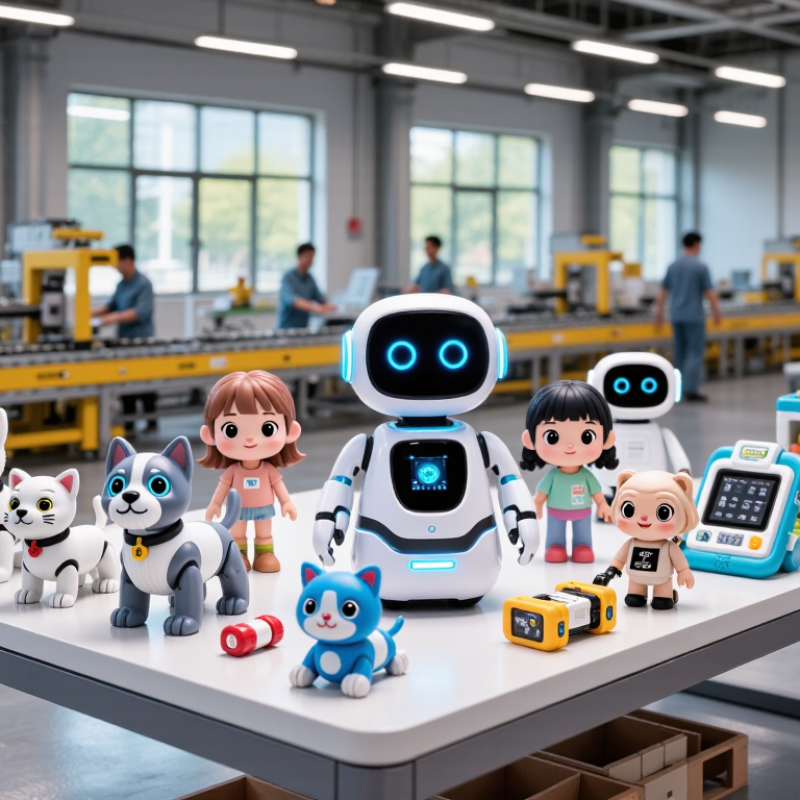
China Top 10 AI Toy Manufacturers for Global Buyers?

What Qualifies as an AI Toy Manufacturer in China?

A Chinese AI toy manufacturer does more than place a speaker and microphone inside a plastic shell. It should demonstrate in-house or accountable expertise across hardware, software, model integration, and product testing. Ask for a working sample: Can the toy understand a child’s spoken request in a noisy room, respond appropriately, and recover when the connection drops? Request clear documentation on data handling, update support, and how conversations are reviewed or deleted. A polished demo is not enough.

Technical capability matters, but child-centered design matters just as much. UNICEF’s Policy Guidance on AI for Children highlights safety, privacy, transparency, and accountability as key considerations. These are practical questions for suppliers, not decorative promises. The Stanford AI Index Report 2025 notes that the cost of using models at GPT-3.5-level performance fell more than 280-fold between November 2022 and October 2024. Lower costs make AI easier to integrate, but they do not prove a toy is reliable or suitable for children. That distinction is easy to miss.

Tips: Ask who maintains the AI after shipment. Request test records for speech recognition, response quality, and offline behavior. Check whether the manufacturer can explain its data flow in plain English. If answers feel vague, pause. Even a strong prototype can fail in a child’s bedroom, where Wi-Fi is weak and questions are unpredictable.

How China’s AI Toy Manufacturing Industry Is Structured

China’s AI toy supply chain is not a single factory line. It usually links component makers, toy assemblers, software teams, and export-service providers. China Toy Association reporting, based on customs figures, put toy exports at about US$40.7 billion in 2023. That figure covers toys broadly, not AI toys alone. The distinction matters.

Factories may source microphones, small speakers, cameras, sensors, and molded plastic parts from different suppliers. Assembly teams then fit these into plush toys, tabletop devices, or wheeled robots. IFR’s World Robotics 2024 report recorded 276,288 industrial robots installed in China in 2023, around 51% of global installations. This signals broad automation capacity, not proof that every toy plant is highly automated. The gap is real.

AI functions often come from a separate layer: speech recognition, cloud services, character dialogue, and app connectivity. A buyer should ask who maintains each function, what happens when Wi-Fi drops, and whether firmware updates are included. Samples can sound impressive. Production batches may differ in microphones, response speed, or battery life. One weak point is fragmented accountability; the assembler may not control the software vendor or every component source. Request a component list, a repeatable test plan, and written ownership of post-shipment support.

How Global Buyers Can Evaluate AI Toy Manufacturers

For global buyers sourcing AI toys in China, a polished sample is only a starting point. Ask how the factory tests voice recognition, sensors, battery life, and response speed. Request a written test plan, not just a demonstration in a quiet showroom. Try the toy in a noisy room and repeat the same command several times. Small differences can reveal weak microphones or inconsistent software. Check who writes and maintains the software, and how updates are handled after shipment. Ask what data the toy collects, where it is stored, and whether families can disable collection. Get clear, documented answers.

Review safety reports and confirm that they match the exact model, materials, and production site under consideration. A report for a similar toy may not cover a changed battery or plastic component. Inspect a production sample, then compare it with units from a later batch. Ask for records showing how defects are tracked and corrected. Visit the factory when practical, or arrange an independent inspection. Check lead times, spare-part access, packaging, and warranty terms in writing. A low quote can hide real costs. One uncomfortable point: even a careful audit cannot guarantee every batch will be flawless, so build inspection time into the order schedule.

China’s Top 10 AI Toy Manufacturers for Global Buyers

China’s top AI toy manufacturers serve buyers looking for connected play, voice interaction, and custom product development. A strong supplier should explain how its team handles hardware design, software integration, production, and quality checks. Ask to see a working sample, not only a polished presentation. Details matter. Check whether the factory can reproduce the sample’s materials, response speed, and sound quality at scale.

During evaluation, test the toy in a noisy room and with different accents. Review how it handles unanswered questions, connection loss, and software updates. Ask what data the product collects, where it is stored, and how long it is retained. For toys intended for children, clear privacy controls and age-appropriate responses deserve close attention. Request current test reports and confirm that they match the product configuration and markets where you plan to sell.

Compare suppliers on more than unit price. Discuss minimum order quantities, packaging changes, spare parts, lead times, and after-sales support in writing. Independent inspections can help verify materials and production consistency before shipment. A factory visit may reveal practical details, such as how workers track defects or separate approved components. Still, no checklist catches everything; even a carefully tested sample may behave differently after a software update. Keep a record of agreed specifications and test the final production batch.

China’s Top 10 AI Toy Manufacturers for Global Buyers

A practical framework for comparing manufacturers—not a verified ranking or company-specific assessment. The percentages are suggested buyer-planning weights and total 100%.

When sourcing AI toys, evaluate child safety and regulatory compliance alongside privacy, product quality, and after-sales support. Adjust the weights to fit your target markets and product requirements.

Export, Safety, and Partnership Considerations

For global buyers, an AI toy is both a play product and a connected device. Ask suppliers for destination-specific test reports, component traceability, and clear records of software updates. Check the details: battery compartments, detachable parts, microphone controls, and the toy’s behavior when Wi-Fi fails. Small omissions matter. The U.S. Consumer Product Safety Commission estimated 145,500 toy-related emergency-room injuries among children aged 12 or younger in 2022. That figure makes independent testing and age-appropriate design practical priorities, not paperwork.

Export readiness also depends on data handling. The International Telecommunication Union reported that 5.5 billion people were online in 2024, widening the need for careful digital safeguards. Ask what voice or usage data the toy collects, where it is stored, and how buyers or caregivers can delete it. Request plain-language answers, not only technical files. Requirements differ by market, so confirm applicable standards and labeling with qualified local specialists before shipment.

A dependable partnership is tested after the sample stage. Compare production samples with mass-production units, agree on inspection points, and set written procedures for defects, software updates, and replacement parts. Review how the factory manages subcontractors and keeps test records current. I would not treat a polished demo as proof of reliability; demos can hide weak connectivity or awkward setup. Ask for a pilot batch and test it in real homes. It takes more time. It often reveals the truth.

China Top 10 AI Toy Manufacturers for Global Buyers? - Export, Safety, and Partnership Considerations

Buyer due-diligence scorecard: The rows below are evaluation criteria, not a ranked list of companies. Requirements vary by destination, product design, age grade, and intended use.

No. Evaluation area Relevant factual baseline Evidence to request from a supplier Buyer check
1 United States toy safety ASTM F963 is incorporated into U.S. mandatory toy-safety requirements under the Consumer Product Safety Act. Applicable children’s products generally require testing by a CPSC-accepted third-party laboratory and a Children’s Product Certificate (CPC). Product-specific test reports, CPC details, age grading, and traceable production-batch records. Confirm the reports cover the exact model, materials, and intended age group.
2 European Union market access Toys placed on the EU market are subject to the Toy Safety Directive 2009/48/EC. Applicable conformity assessment, technical documentation, a Declaration of Conformity, and CE marking are part of the compliance process. EU Declaration of Conformity, technical-file index, applicable test reports, and CE-marking artwork. Check that the named product and cited legislation match the goods being ordered.
3 United Kingdom requirements The Toys (Safety) Regulations 2011 govern toy safety in Great Britain. Northern Ireland follows applicable EU rules under the Windsor Framework; marking and conformity routes can differ by market and current rules. Market-specific declaration, safety documentation, marking plan, and importer details where required. Specify Great Britain or Northern Ireland separately in the compliance brief.
4 Canada toy requirements Canada’s Toys Regulations (SOR/2011-17) set safety requirements, including restrictions related to hazards such as small parts and toxic substances. Applicable obligations depend on the product and its intended users. Canadian-market test results, product warnings, age grading, and a documented materials list. Review the finished product and packaging against Canadian rules before shipment.
5 Small parts and age grading Small-parts restrictions and warning requirements depend on destination-market law and the toy’s intended age group. A product marketed for young children can face stricter requirements. Age-grading rationale, small-parts test results where applicable, warnings, and packaging proofs. Check foreseeable use and misuse, not only the supplier’s suggested age label.
6 Materials and chemical compliance Chemical restrictions differ by market and may apply to accessible materials, coatings, plastics, and components. EU REACH restrictions and toy-specific chemical limits may be relevant to products sold in the EU. Bill of materials, supplier declarations, risk-based chemical test reports, and controls for material substitutions. Make any material or component change subject to buyer approval and reassessment.
7 Electronics, batteries, and radio functions AI toys with wireless connectivity may trigger additional market-specific requirements. For example, EU radio equipment is covered by the Radio Equipment Directive; U.S. radio-frequency devices may require applicable FCC authorization. Radio-module specifications, applicable conformity documents, battery safety information, and charging instructions. Identify every wireless feature, frequency band, battery type, and destination market.
8 Voice data and child privacy A connected toy that collects children’s personal information can raise privacy obligations. In the United States, COPPA applies to covered online services directed to children under 13 or with actual knowledge of collecting their personal information. Data-flow diagram, privacy notice, consent and deletion processes, retention schedule, and security-update policy. Establish who operates the app or cloud service and who is responsible for compliance and incident response.
9 Export documents and shipment readiness International shipments commonly use commercial invoices, packing lists, and transport documents. Customs classification, origin declarations, and other documents depend on the goods and destination-country rules. Draft invoice and packing list, proposed HS classification, country-of-origin details, and export packing specifications. Have the buyer or customs broker verify classification, duties, and document requirements before dispatch.
10 Quality systems and partnership terms A quality-management certificate, such as ISO 9001, concerns a management system; it does not by itself certify a specific toy as safe or compliant. Commercial terms such as MOQ, lead time, tooling ownership, and remedies must be agreed contractually. Current audit or certificate scope, inspection plan, sample-approval process, written lead times, and contract terms. Agree inspection, change-control, defect-remedy, IP, and delivery terms before production.

Note: This table provides a general procurement framework, not legal advice or a certification determination. Confirm current requirements with the relevant regulator, accredited testing provider, or qualified customs and compliance professional for each destination market.

FAQS

What should a capable AI toy manufacturer provide?

It should show accountable skills in hardware, software, model integration, and product testing. Ask for a working sample, not slides.

How can buyers test voice recognition?

Try repeated commands in a noisy room. Then test weak Wi-Fi and watch how the toy recovers. Small differences matter.

What should buyers ask about data?

Ask what voice or usage data is collected, where it is stored, and how caregivers can delete it. Get plain-language answers.

Does a polished demonstration prove product quality?

No. A quiet showroom can hide weak microphones, unstable connections, or awkward setup. Low integration costs do not prove child suitability.

Which safety documents should buyers review?

Request reports matching the exact model, materials, and production site. Check battery compartments, detachable parts, microphone controls, and age suitability.

How can buyers check mass-production quality?

Compare a production sample with units from later batches. Review defect records and arrange independent inspections when practical. I would not trust one clean sample alone.

What export details need confirmation?

Request destination-specific test reports, component traceability, software-update records, and clear labeling details. Confirm requirements with qualified local specialists before shipment.

What makes a reliable supplier partnership?

Put inspection points, defect handling, updates, spare parts, lead times, and warranty terms in writing. Consider a pilot batch in real homes. It takes longer. It may reveal problems a showroom misses.

Conclusion

This guide explains what distinguishes an AI toy manufacturer from a conventional toy producer, including the ability to combine age-appropriate hardware, interactive software, and reliable product development. It also outlines how China’s manufacturing landscape is organized, from design and component sourcing to assembly and quality control. For global buyers, the article offers practical ways to assess potential suppliers, such as reviewing technical capabilities, production capacity, communication, customization options, and quality-management processes.

The guide also presents ten types of manufacturers for buyers to compare, without treating any single supplier as the right fit for every project. It highlights the importance of clear export planning, product testing, safety documentation, data protection, and transparent partnership terms. By considering these factors early, buyers can make more informed sourcing decisions and develop AI toys that are suitable for their intended markets and audiences.

Evelyn

Evelyn

Evelyn is a professional marketing specialist who combines a strong understanding of the company’s products with a clear, customer-focused approach to communication. She regularly contributes expert articles to the company website, sharing practical guidance, product knowledge, and insights to help......