AI Smart Pet
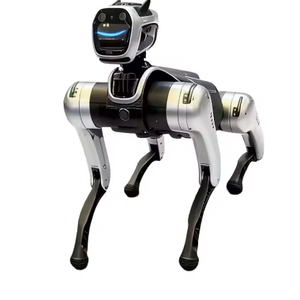
Precision-molded bionic chassis, dynamic eight-wheel wheel-leg drivetrains, and embedded 6-axis spatial IMU gesture tracking engineered for consumer retail, STEM education, and smart companion ecosystems.
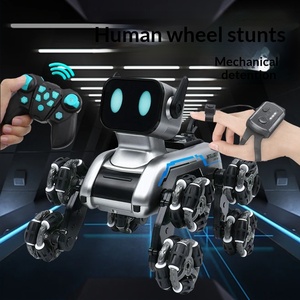
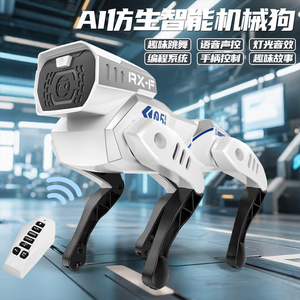
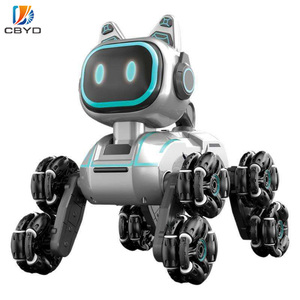
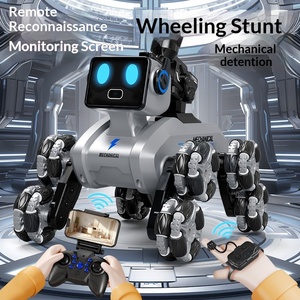
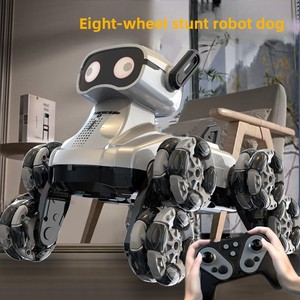

In the landscape of consumer electronics and robotic toys, transitioning from basic infrared line-of-sight tracking to multi-dimensional somatosensory recognition is the primary technical watershed. As a dedicated OEM/ODM manufacturer headquartered in Shenzhen's core industrial cluster, our architectural approach integrates high-precision 6-Axis Inertial Measurement Units (IMU) directly into wearable wrist controllers or glove modules. These transceivers decode real-time pitch, yaw, and roll vectors, mapping angular velocity to motor drive outputs via low-latency 2.4GHz RF and BLE 5.2 proprietary protocols.
The kinematic subsystem in our custom robot dog platforms moves beyond standard dual-motor toy chassis. By coordinating micro-geared servos and brushless drive modules within transforming eight-wheel linkages, our quadruped and stunt wheel architectures achieve 360-degree omnidirectional drift, obstacle surmounting, and dynamic posture leveling. When sourcing gesture control robotics, B2B procurement teams must assess firmware filtering algorithms: our custom Kalman filtering dampens erratic hand tremors, translating natural human body language into smooth, lifelike canine behaviors, pouncing stunts, and precise navigational execution.
Microcontroller units (MCUs) running edge-level signal filtering ensure gesture recognition is processed in less than 15 milliseconds, eliminating sensory latency between hand articulation and robotic motion response.
Independent multi-joint suspension systems dynamically morph between low-profile high-speed crawling and articulated upright stunt climbing over high-angle carpet transitions and outdoor terrains.
Gesture control modules work concurrently with capacitive touch patches, acoustic voice recognition chips, and optical obstacle avoidance arrays to formulate full-spectrum smart companion reactions.
Enterprise procurement specialists at international retail chains, educational supply syndicates, and lifestyle brand distributors must anticipate rapid generational shifts in interactive hardware. The market is aggressively pivoting away from disconnected toys toward unified smart ecosystems. The table below illustrates the industrial evolution transforming gesture-controlled robotic pets.
| Evaluation Parameter | Legacy Generation (2020–2023) | Current Market Standard (2024–2025) | Next-Gen OEM Roadmaps (2026+) |
|---|---|---|---|
| Gesture Sensor Technology | Infrared reflection (short range, high ambient light failure) | 6-Axis IMU Wearable Watch / 2.4GHz RF Link | Embedded ToF Camera + Computer Vision Optical Gesture Tracking |
| Drivetrain Mechanics | Rigid 4-wheel drive or non-articulated legs | Eight-wheel transforming stunt arms with dual-mode conversion | High-torque micro-brushless servos with full bionic 12-DOF articulation |
| Interactive Intelligence | Fixed audio IC playback with repetitive sound bites | Offline speech recognition in up to 37 languages | On-device SLM (Small Language Model) & Cloud LLM Embodied Intelligence |
| Battery & Charging | Exposed Ni-MH cells or fragile micro-USB ports | Modular lithium packs with integrated overcharge protection (BMS) | GaN fast-charging docks with inductive magnetic contact charging |
| Firmware Adaptability | Burned OTP ROM (No post-production updates) | Wired USB flashing for localized language SKU changes | BLE / Wi-Fi OTA (Over-The-Air) firmware and behavior customization |
From a commercial sourcing perspective, procurement trendlines prioritize modular software stacks. International distributors increasingly demand common hardware chassis that can be flashed with regional acoustic datasets (English, Spanish, Arabic, Russian, Japanese) during final packaging assembly. This cuts inventory carrying costs while accommodating localized consumer expectations. Furthermore, sustainable manufacturing regulations (such as the EU Battery Directive and Ecodesign guidelines) mandate toolless battery compartment access and non-toxic ABS/polycarbonate formulations capable of passing strict drop-impact endurance standards.
Operated by Shenzhen Atp Intelligent Electronics Co., Ltd., our production ecosystem unifies the entire value chain of interactive robotics and smart toys under one roof. Unlike trading brokers or single-process assembly workshops, we systematically bridge mechanical toolmaking, surface-mount PCB electronics (SMT), acoustic chamber tuning, and soft plush exterior over-molding.
High-speed surface mount lines manufacture high-density mainboards, wearable gesture transmitter modules, and multi-channel motor driver boards with rigorous automated optical inspection (AOI).
Pre-compliance verification against ASTM F963 (USA), EN 71 parts 1-3 (Europe), CPSIA, IEC 62115 (Electric Toy Safety), and RED/FCC RF emissions directives handled prior to pilot run sign-off.
In-house CNC mold machining facilities drastically shorten cycle times from rapid 3D prototyping to hardened steel multi-cavity injection molds, protecting clients' proprietary exterior designs.
Direct answers addressing tooling timelines, radio certification, firmware localization, and quality assurance workflows.
Yes. Our firmware team calibrates deadband filtering, acceleration thresholds, and gesture mapping tables to match your target user demographic (e.g., simplified coarse inputs for toddlers vs. fine precision drift commands for teenagers).
Our 2.4GHz RF systems feature dynamic automatic frequency-hopping spread spectrum (FHSS) technology. Up to 30 robots can perform simultaneously in close physical proximity without control crossover or dropped packet latency.
Rapid functional prototypes (3D printed SLA/SLS chassis with pre-calibrated development PCBs) ship within 10 to 14 business days. Steel tooling production, plastic mold injection, and T1 functional trial samples require 35 to 45 calendar days.
All integrated battery cells feature PCM/BMS circuitry preventing over-discharge, over-voltage, and short-circuits. We supply verified UN38.3 test reports, MSDS dossiers, and certified drop packaging documentation for sea and air cargo clearance.
Absolutely. We accommodate full-spectrum private label manufacturing, including custom injection mold modifications, UV silk-screen branding, bespoke Pantone plastic coloration, custom packaging boxes, and multilingual instruction manuals.
Standard catalog models with client branding and localized packaging start at an accessible MOQ of 1,000 units. Fully custom industrial designs requiring dedicated injection molds typically begin at 3,000 to 5,000 units per production run.
Consult directly with our Shenzhen engineering division to obtain comprehensive BOM cost estimates, CAD mechanical validations, and regulatory roadmaps tailored to your commercial distribution territory.
Get a Quote