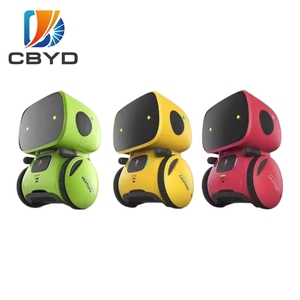
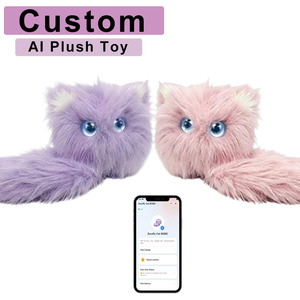
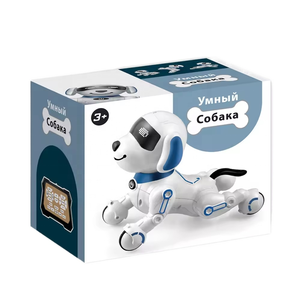
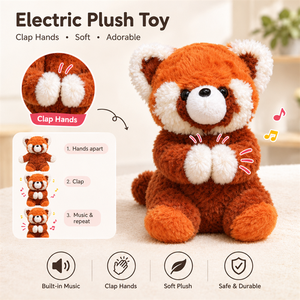
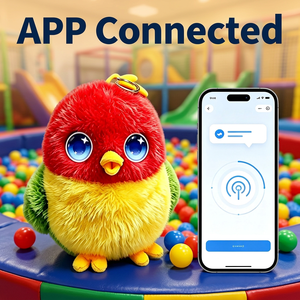
Voice Assistant Robot Plush with Emotional Companionship and Long-term Memory for Kids Tech Gift Box Wholesale Manufacturer
- Dual-Core MCU with Sound Chamber
- Adaptive Singing Pitch Modulation
- Child-Safe Hypoallergenic Shell
Explore our turnkey robotic architectures. Each platform features balanced electro-acoustic resonance, internal anti-damping housing, dynamic motor synchronization, and modular firmware designed for private-label deployment.
Why consumer-grade smart singing toys encounter catastrophic RMA failure rates without rigorous integration between plush casing, thermal dissipation, mechanical gear trains, and digital sound processing.
In standard toy manufacturing, soft goods and electronics are routinely treated as isolated engineering siloes. A vendor develops an injection-molded shell or sewing pattern, buys an off-the-shelf sound chip, and attempts final assembly without considering acoustic attenuation or physical resonance. When stuffed with polyester fibers, a 75dB speaker is frequently smothered down to an indistinct 52dB mumble. Conversely, driving volume to overcome stuffed materials introduces unbearable harmonic distortion, thermal clipping on micro-amplifiers, and battery drainage that damages brand reputation.
Achieving lifelike singing behavior requires synchronized cooperation between three distinct subsystems: the Digital Audio Synthesizer, the Kinetic Kinematic Train, and the Closed-Loop Power Management Unit.
We eliminate muffled audio via proprietary isolated sound boxes. By engineering micro-tuned reflex ports and decoupling the speaker basket from structural vibrating motors, we prevent buzz, mechanical hum, and mid-range audio compression across all musical scales.
Singing robots require natural mouth, ear, and head dance kinematics synchronized to BPM rhythm. We deploy low-noise POM gearboxes and high-cycle carbon-brush micro motors, limiting operating noise beneath 32dBA so motor whirr never interferes with audio tracks.
Our custom ARM Cortex-M0/M4 firmware pipelines audio streams through an on-the-fly Fast Fourier Transform (FFT) analysis. This drives PWM servo channels in microsecond synchrony with vocal peaks, creating fluid biological movement rather than mechanical jerking.
Macro analysis for toy brand directors, retail category merchandisers, and consumer tech sourcing managers preparing for next-generation interactive play products.
The global market for vocalizing, musical, and companion robotics is transitioning rapidly away from static, pre-recorded OTP (One-Time Programmable) sound chips toward contextual audio generation, multimodal user interaction, and sustainable circular componentry. Sourcing teams that fail to anticipate these technological shifts risk commercial obsolescence within two seasonal product cycles.
Historically, an OEM singing robot stored 3 to 12 songs inside a 4MB SPI Flash memory. Once a child listened through the sequence, engagement plummeted. The market is shifting decisively toward Edge-AI and Wi-Fi streaming architectures. Using miniaturized Wi-Fi 6 / BLE 5.3 combo chipsets, robots can stream dynamically synthesized personalized melodies, incorporate a child's name into lyrics, and adjust tempo in response to physical motion and cuddle velocity.
Regulatory scrutiny over children's electronics has intensified across North America (ASTM F963-23, CPSIA, COPPA) and the European Union (EN 71-1:2014+A1:2018, IEC 62115, RED Directive, and GDPR-K). Modern procurement briefs now mandate hardware-enforced volume governors. Even under peak battery voltages, vocal outputs cannot exceed 65dBA for toys intended for close-to-the-ear play. Furthermore, microphone-enabled vocal robots require physical kill-switches and local on-chip wake-word verification to guarantee no raw audio leaves the local device without parental consent.
Enterprise retailers including Target, Walmart, and Smyths Toys have established strict ESG goals requiring recycled PCR (Post-Consumer Resin) plastics and GRS (Global Recycled Standard) plush textiles. Because recycled polymers exhibit variable structural densities and unpredictable resonance frequencies, OEM partners must maintain in-house acoustic simulation labs to adjust internal baffling dynamically, maintaining vocal clarity across diverse recycled resin lots.
| Architecture Level | Core Processor / Module | Audio Capabilities | Motion Sync Latency | Target Retail Category | Unit Cost Tier |
|---|---|---|---|---|---|
| Level 1: Classic Hardwired | 8-bit OTP Microcontroller | Fixed 8kHz - 16kHz WAV/ADPCM (1-3 min) | Pre-baked trigger sync (>120ms) | Impulse retail, seasonal novelty plush | Budget ($) |
| Level 2: Dynamic MP3/DSP | 32-bit RISC DSP + MicroSD/SPI | 24-bit 48kHz Hi-Fi DAC, pitch shift | Hardware interrupt sync (40-60ms) | Educational musical toys, branded IP | Mid-Range ($$) |
| Level 3: Connected Smart AI | Dual-Core ESP32-S3 / Linux SoC | Real-time streaming, generative lyrics | Microsecond algorithm sync (<15ms) | Companion AI robots, premium tech gifts | Premium ($$$) |
| Level 4: Multimodal Edge LLM | NPU Accelerated Edge Processor | On-device TTS, emotional vocal nuances | Closed-loop real-time kinematic sync | Advanced interactive bionic robots | Enterprise ($$$$) |
From initial acoustic simulation and 3D rapid prototyping to automated SMT board placement, sonic welding, and 100% audio spectrum testing in anechoic test stations.
Rapid stereolithography (SLA) prototypes analyze speaker air back-volumes, seal rings, and motor vibration transmission before steel tooling is cut.
In-house high-speed SMT lines place microcontrollers, Class-D audio amplifiers, and power management circuits with 100% automated optical inspection (AOI).
Every robot passes through a calibrated sound booth to verify frequency response curves, total harmonic distortion (THD < 2%), and maximum legal dBA boundaries.
Units undergo drop tests from 1.5 meters, wire tensile pull-testing (90N), 100,000-cycle motor endurance checks, and salt-spray corrosion resistance tests.
Located in the heart of Shenzhen’s Baoan & Longgang electronic toy corridors, Shenzhen Atp Intelligent Electronics Co., Ltd. (operating AItoyplays) maintains a specialized manufacturing facility bridging mechanical robotics, plush tailoring, and smart consumer IoT electronics.
Accelerate your custom OEM quotation by submitting a technical brief containing these primary engineering variables:
✔ Enclosure Medium: Plush-covered ABS chassis, full silicone outer skin, or high-impact rigid polycarbonate casing.
✔ Kinematic Degree of Freedom: 1-DoF (mouth only), 2-DoF (mouth + head tilt), or multi-axis walking/dancing chassis.
✔ Acoustic Input/Output: Preloaded songs via OTP/Flash, Bluetooth auxiliary streaming, or cloud-connected Wi-Fi interaction.
✔ Power Source: Replaceable AAA/AA battery box (with safety screw lock) vs. USB-C rechargeable Li-ion pack with BMS protection.
✔ Regulatory Jurisdictions: US (ASTM F963, FCC Part 15), EU (EN 71-1/2/3, CE-RED, RoHS), or Global certifications.
Direct answers from our engineering desk regarding lead times, acoustic limitations, testing certifications, and tooling amortizations for custom robot manufacturing.
We implement a dual-phase noise reduction strategy: mechanically, we isolate electric gear trains using damping silicone mounts and low-friction polyoxymethylene (POM) gears that operate below 30dBA. Electrically, we isolate the audio amplifier rail with dedicated LC filtering to prevent motor EMF back-feed and high-frequency PWM switching buzz from entering the speaker line.
Yes. EN 71-1 and ASTM F963 dictate strict continuous acoustic exposure limits (typically ≤65dBA for close-to-the-ear toys, ≤85dBA at 50cm for floor toys). We tune our Class-D amplifier feedback resistors and apply digital peak limiting inside the firmware DSP, ensuring that even under fresh high-discharge lithium battery conditions, decibel ceilings are never breached.
A typical OEM/ODM cycle spans: 10–14 days for industrial CAD and acoustic SLA mockups; 18–25 days for functional electronic PCB layout and first-article golden sample generation; 35–45 days for multi-cavity injection mold tooling; and 30–35 days for initial mass production run (including ICT, AOI, aging tests, and packaging).
Buyers can provide their own proprietary master sound files (WAV/MP3) along with proof of mechanical licensing. Alternatively, our in-house content team can source and program royalty-free public domain traditional nursery rhymes, or commission proprietary bespoke musical arrangements tailored exclusively to your brand IP.
For custom ODM modifications using our pre-existing motor-chassis or voice-module architectures, MOQ begins at 1,000 to 2,000 units per production run. For entirely custom ground-up plastic injection molds and bespoke PCB tooling, initial production MOQs typically range from 3,000 to 5,000 units, with tooling NRE amortized across agreed order volumes.
All our integrated rechargeable lithium-polymer battery packs carry certified Battery Management System (BMS) circuits safeguarding against overcharging, over-discharging, short-circuit, and thermal runaway. Packs are rigorously certified under UN38.3, IEC 62133, and UL 2054, encased inside puncture-resistant internal safety bulkheads.
Consult directly with our Shenzhen electronic toy engineering team. Share your target retail price, character sketches, functional requirements, and anticipated volumes for an NDA-protected development evaluation within 24 hours.