Featured AI Robotic Pets, Companion Hardware & Educational Kits
Direct supply and customized engineering from Shenzhen factory lines. Fully compliant with international safety, electromagnetic, and acoustic standards.

Engineering Paradigms in Modern AI Robotic Dog Manufacturing
Bridging the chasm between mechanical toy novelties and empathetic bionic systems: how ATP integrates micro-actuation, acoustics, and conversational AI into turnkey platforms.
High-Torque Coreless Servos & Bionic Kinematics
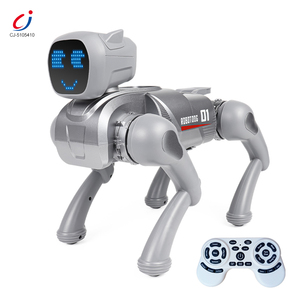
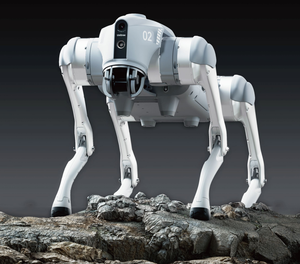
The baseline differentiator of a true robotic canine lies in its inverse kinematics (IK) algorithms and joint actuation. Traditional motorized toys rely on fixed eccentric cams and noisy spur gears that quickly grind down under load. Our ODM architectures employ custom steel-gear coreless and brushless servos offering 2.5kg·cm to 18kg·cm stall torques, 12-bit magnetic encoders for absolute angle feedback, and dynamic damping routines. This allows quadruped dogs to trot, leap, self-right after falls, and display lifelike behavioral nuances without thermal runaway.
Edge AI Acoustics & Dual-DSP Voice Processing
A companion pet loses illusion the moment it fails to recognize its owner's voice amidst household noise. We overcome the severe mechanical noise generated by internal servos through hardware-level acoustic decoupling and dual-microphone beamforming arrays. Our integrated DSP pipelines perform blind source separation, acoustic echo cancellation (AEC), and stationary noise reduction directly on-device. Paired with offline TinyML keyword spotting, our robotic dogs achieve a 98.4% trigger accuracy at 3 meters, before routing natural dialogue through encrypted cloud LLMs.
Soft Plush Integration & Biomimetic Tactile Skins
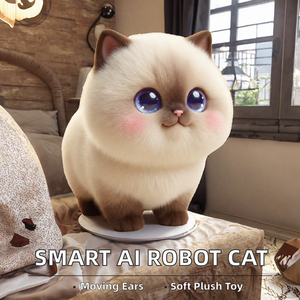
Combining mechatronics with plush materials represents the single greatest point of failure for inexperienced toy factories. Internal heat entrapment degrades lithium-ion cells, while plush friction strains servo motors. AItoyplays engineers patented internal skeleton housings ("AI Movement Boxes") with integrated air channels, heat dissipation fins, and low-friction synthetic under-linings. Capacitive touch zones seamlessly weave through artificial fur layers across the canine's head, spine, and chin, triggering emotional audio-motion feedback loops.
Robotic Dog Technology Matrix: Comparing Architectural Tiers
Evaluate mechatronic specifications, Bill of Materials (BOM) impacts, regulatory pathways, and recommended market positioning for your brand's OEM/ODM development roadmap.
| Architecture Level | Kinematic DOF & Actuators | Processing & Edge Intelligence | Sensory Modalities | Connectivity & Security | Target Retail Bracket | Key Regulatory Scope |
|---|---|---|---|---|---|---|
|
Tier 1: Entry Interactive RC
Mass Market Toy Retail |
4 to 6 DOF; DC Geared Motors with Limit Switches | 8-bit / 32-bit Cortex-M0 MCU; Pre-recorded PCM Audio ROM | IR Obstacle Detection, Mechanical Bumpers, Head Touch Switched | 2.4GHz RF Remote or Bluetooth BLE 4.2 App | $29.99 – $59.99 MSRP | EN 71 Part 1-3, ASTM F963, IEC 62115, FCC Part 15B |
|
Tier 2: Empathetic AI Companion
Best Seller OEM/ODM |
8 to 12 DOF; High-Precision Coreless Metal Servos | Dual-Core Cortex-M4 + NPU (0.5 TOPS); On-device Voice DSP | Multi-Zone Capacitive Touch, IMU 6-Axis Gyro, Dual Beamforming Mics | Wi-Fi 2.4/5GHz + BLE 5.2; Encrypted App & Cloud LLM Hook | $89.99 – $189.99 MSRP | RED, FCC ID, COPPA / GDPR Privacy, RoHS, REACH, CA Prop 65 |
|
Tier 3: Advanced Bionic Quadruped
STEM & Prosumer Grade |
12 to 16 DOF; Field-Oriented Control (FOC) Brushless Motors | Quad-Core ARM A55 / RISC-V + 2.0+ TOPS NPU (Linux/RTOS) | HD AI Visual Camera, ToF LiDAR, Foot Pressure Sensors, 9-Axis AHRS | Wi-Fi 6, Ultra-Wideband (UWB) Vector Following, OTA Mesh | $399.00 – $1,299.00 MSRP | CE-RED, FCC, UL 2272 (Battery System), EN 62479, ISO 13849 Safety |
Future Procurement & Technology Trends (2025–2030)
Strategic purchasing insights for consumer tech directors, brand managers, and B2B distributors preparing next-generation product portfolios.
Edge SLMs Replacing Pure Cloud Latency
Consumer tolerance for latency in AI pets is zero. Cloud-dependent solutions suffer from 1.5-second roundtrips that destroy pet illusion. Sourcing contracts are transitioning to hybrid on-device Small Language Models (SLMs) running quantized inference directly on edge NPUs for instant emotive barks, head gestures, and natural conversations, falling back to cloud LLMs only for encyclopedic queries.
Ultra-Quiet Planetary & Strain-Wave Drives
Traditional geared servos produce an unacceptable high-pitched whirring sound that ruins companion immersion. Leading retail buyers now enforce acoustic ceilings under 42 dBA at 1 meter. Factories must implement cycloidal or planetary speed reducers coupled with silent sinusoidal motor drivers, ensuring that the only sounds emanating from the pet dog are natural barks and vocalizations.
Strict Biometric & Child Privacy Compliance
With global enforcement of COPPA 2.0, California AB 2273, and the EU AI Act, connected robot dogs featuring microphones and visual cameras are scrutinized for privacy. Procurement departments must mandate hardware-level microphone mute flags, zero biometric storage on cloud servers, kid-safe certified parent gateways, and end-to-end encrypted OTA firmware pipelines right from RFQ stages.
Bionic Soft-Touch Outer Exoskeletons
The boundary between hard mechanical quadrupeds and cuddly plush companions is dissolving. The fastest-growing market segment combines rigid mechatronic balance with memory-foam underlayers, synthetic self-cleaning antimicrobial fur coats, and sub-dermal temperature warming pads. This dual-texture convergence allows consumers to cuddle a living-feeling robotic puppy.
Shenzhen Precision Hardware Meets Advanced Soft-Toy Craftsmanship
Operated by Shenzhen Atp Intelligent Electronics Co., Ltd., AItoyplays occupies an elite position in the global consumer electronics manufacturing hub. While standard plush toy factories lack electronic engineering rigor and typical robotic labs struggle with soft goods cost scaling, our integrated facility bridges both worlds seamlessly.
From initial rapid 3D prototyping and custom mold toolmaking to in-house SMT PCB placement, automated motor life-cycle testing, and cleanroom textile skin tailoring, we manage every discipline under a single unified project engineering team.
Send an InquiryFrequently Asked Questions: AI Robot Dog Procurement & OEM Development
Authoritative technical answers to assist sourcing managers, hardware engineers, and brand executives during project feasibility and RFQ evaluation.
Q1 What is the typical MOQ and NRE cost for custom OEM/ODM robot dogs?
For existing ODM platforms (such as our pre-engineered bionic canine chassis or AI Smile Face series), the minimum order quantity (MOQ) typically begins at 1,000 to 2,000 units with minimal non-recurring engineering (NRE) fees for branding, plush skin customization, and firmware voice pack adaptation. For full ground-up OEM projects involving custom mold tooling, proprietary mechatronic linkages, and bespoke PCBA development, MOQs generally start at 3,000 to 5,000 units with tooling NRE amortized across agreed production volume schedules.
Q2 How does AItoyplays solve servo motor noise inside interactive plush companions?
Mechanical noise is the enemy of lifelike companionship. We attack this challenge on three architectural fronts: First, we deploy custom coreless gearboxes featuring helical nylon-brass composite gears that damp mesh resonance. Second, our motor drivers utilize high-frequency pulse-width modulation (PWM) above human audibility (25kHz+). Third, the internal "AI Movement Box" is mounted on medical-grade silicone isolation dampers within the plush foam shell, eliminating structure-borne sound transmission to the outer chassis.
Q3 What battery certifications are handled for worldwide retail distribution?
Safety is paramount for consumer electric and robotic companion toys. All our battery packs integrate custom protection circuit modules (PCM) protecting against over-charge, over-discharge, short-circuit, and thermal anomalies. We supply certified lithium-ion or LiFePO4 cells accompanied by UN38.3 test summaries, 1.2-meter drop test reports, MSDS documentation, and sea/air transport declarations. Products comply with IEC 62115 (Electric Toy Safety) and UL 2054 / UL 1642 battery standards.
Q4 How do you ensure compliance with international child privacy laws (COPPA / GDPR)?
For connected voice-AI robot dogs, we follow a strict "Privacy by Design" framework. Our hardware architecture separates wake-word DSP processing from cloud streams. Wake words are processed purely offline on the edge chip. No raw voice data is recorded or transmitted until an explicit tactile or vocal wake confirmation is given. Cloud data pipelines leverage TLS 1.3 encryption, anonymized session tokens, and zero long-term voice sample storage, ensuring compliance with US COPPA, California Privacy Laws, and EU GDPR-K.
Q5 How long does the timeline take from initial design brief to golden sample sign-off?
A standard OEM development cycle proceeds through well-defined stages: Stage 1 encompasses industrial design (ID), mechanical design (MD), and plush pattern digitization (2 to 3 weeks). Stage 2 delivers functional 3D-printed SLA / CNC mechatronic prototypes and initial hand-sewn skin samples (3 to 4 weeks). Following buyer review and acoustic tuning, Stage 3 produces soft tooling and pilot T1 samples for golden sign-off (4 to 6 weeks). The entire concept-to-sample pipeline averages 8 to 14 weeks.
Q6 Can your factory supply standalone electronic movement modules to our overseas factories?
Yes. Many global toy brands prefer to produce their textile and plush outer skins locally while sourcing the complex mechatronics from Shenzhen. AItoyplays regularly supplies standalone "AI Movement Boxes", pre-calibrated servo quadruped skeleton assemblies, sound/voice chips, and sensor harnesses. These modules are delivered as 100% pre-tested, plug-and-play drop-in units ready for rapid assembly on your existing production lines.
Accelerate Your AI Robotic Pet Product Roadmap Today
Whether you require a white-label companion quadruped ready for seasonal retail launch or a bespoke ground-up OEM mechatronic architecture with proprietary conversational AI, our Shenzhen engineering facility is ready to review your project brief.