150+
Patented Toolings & Core Assemblies
<200ms
Edge Semantic Audio Processing
100%
Traceable DFM & Lab Validation
35+
Global Importer Jurisdictions
Product Verification
Enterprise Product Recommendations & Production Matrix
Direct supply line allocations from our integrated Mechatronics and Embodied AI Assembly workshops. Each model supports granular white-label firmware, silicon variation, and chassis customization.

Engineering Deep-Dive
Defining the LOOI Standard: Embodied AI on the Desktop
The emerging consumer robotics category is shifting from static novelty items to autonomous embodied companions. The benchmark set by hardware ecosystems such as the LOOI robot represents an architectural convergence: high-precision micro-servos, multi-modal sensory input, smartphone compute offloading or high-efficiency edge neural processing, and dynamic personality engines.
As a seasoned contract manufacturer and original ODM developer, our facility addresses the common structural bottlenecks buyers encounter when sourcing LOOI-class hardware. We integrate low-backlash planetary reduction gearboxes, surface-acoustic-wave filtering for noise rejection during speech recognition, and custom circular AMOLED display drivers that reproduce lifelike biomechanical eye kinematics without thermal throttling.
Macro Dynamics
Future Procurement Trends in Desktop & Companion Robotics (2026–2030)
Global consumer demand is transitioning rapidly. Procurement teams, toy brands, and electronic distribution conglomerates must realign their sourcing specifications around four core paradigms.
1. Hybrid Edge-Cloud Inference Architecture
Buyers are discontinuing cloud-only dependencies. Future LOOI-class models demand local SLM (Small Language Model) inference for rapid wake-word recognition, fall detection, and essential gesture controls, falling back to encrypted cloud multi-modal LLMs for open-ended conversation. This significantly reduces persistent server costs for brand owners.
2. Zero-Wear Magnetic & Sensor Docking
The standard procurement specification has migrated away from fragile USB micro-leads. High-end interactive desktop robots now leverage magnetic inductive docking, bi-directional pin arrays, and high-frequency wireless communications, extending device duty cycles past 15,000 continuous hours in domestic and office setups.
3. Stringent Privacy & On-Premise Sandboxing
Children's and desktop surveillance regulations across the US (COPPA Rule updates) and the European Union (AI Act & Cyber Resilience Act) demand that camera tracking and acoustic localization are handled directly on the local visual chip (VPU), eliminating unauthorized transmission of raw video streams to external endpoints.
Technology Horizon
Product Evolution: The Path from Toy to Autonomous Agent
A strategic breakdown of technological shifts informing product managers during RFP development and technical benchmarking.
Stage 1: Scripted Kinematics
Pre-programmed RC actions, localized optical barrier detection, standard infrared remote control, and static sound bite playback via EEPROM.
Stage 2: Sensor Feedback
Capacitive touch nodes, 6-axis IMU for fall detection, micro-stepper motors, and dynamic LED facial matrixes reacting to orientation changes.
Stage 3: Connected Voice AI
Wi-Fi 6 IoT integration, streaming audio gateways, full-duplex conversational buffering, and external ChatGPT/Claude integration pipelines.
Stage 4: Autonomous LOOI Desktop
Sensory fusion combining Time-of-Flight (ToF) table-edge detection, visual object tracking, biomechanical emotive eye UI, and autonomous exploratory states.
Factory Pedigree
Shenzhen ATP Intelligent Electronics Ecosystem
Operating as the manufacturing backbone for global brands, our facilities are physically stationed in Shenzhen, Guangdong—the epicenter of precision mold manufacturing, motor micro-assembly, and semiconductor distribution.
Unlike purely soft-goods toy factories or pure PCB design houses, our core competency lies in the mechanical and acoustic bridging point. We solve the hard mechanical challenges: mitigating motor whine next to high-sensitivity microphones, eliminating heat entrapment in sealed composite bodies, and certifying complex smart devices under tight timelines.
- Integrated Electronics & Plush Co-Design: In-house SMT lines, acoustic chamber tuning, and CNC pattern precision.
- Turnkey DFM Review: Tooling draft analysis, cable-flex fatigue testing, and injection mold flow simulation before tool opening.
- Multi-Market Certification Support: Laboratory protocols for CE, FCC, RoHS, REACH, ASTM F963, EN 71, and IEC 62115.
OEM/ODM Execution
Comprehensive B2B Engineering Disciplines
Our cross-functional project teams manage each lifecycle stage, reducing the engineering overhead typically borne by the importer's sourcing division.
- Acoustic Isolation Engineering: Structural baffling to decouple internal motor vibrations from edge-microphones, preserving speech recognition accuracy.
- Kinematic Drive Calibration: Custom gearing mechanisms utilizing high-torque nylon-polyacetal blends for silent, backlash-free movements.
- Circular UI/UX Graphic Pipelines: Firmware integration for round AMOLED and LCD panels, enabling fluid 60fps organic visual expressions.
- Secure Firmware Deployment: Encrypted bootloaders, dedicated cryptographic chips, and cloud OTA (Over-The-Air) update architecture.
Direct communication lines with native-speaking mechatronic project managers in Shenzhen. Accelerated sampling schedules available for enterprise B2B RFP evaluations.
Procurement Directives
Frequently Asked Questions: Sourcing LOOI & AI Robotic Platforms
Direct answers addressing the compliance, engineering, software licensing, and supply-chain parameters evaluated by B2B buyers and product directors.
What is the standard OEM/ODM Minimum Order Quantity (MOQ) for custom LOOI-type robotic platforms?
For custom ODM modifications utilizing our existing chassis and mechatronic drive assemblies, the standard MOQ starts at 1,000 to 2,000 units per production run. For ground-up OEM developments requiring bespoke injection molds, unique kinematic gear trains, and custom-shaped AMOLED bezel housings, the MOQ typically begins at 3,000 to 5,000 units to amortize tooling and validation fixtures.
How are LLM recurring API overheads, privacy regulations, and latency managed?
We provide hybrid cloud middleware architectures. Brands can choose to integrate their own API endpoints (OpenAI, Anthropic, open-source models on AWS/Azure), maintaining full ownership of token billing and user sessions. For latency minimization, we implement edge VAD (Voice Activity Detection) and wake-word processing on the local chip, achieving voice response latencies under 800ms globally over standard Wi-Fi.
Can you manufacture hybrid units combining desktop robotics with plush materials?
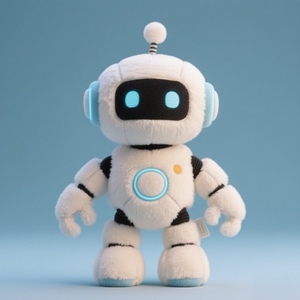
Yes. That is a core specialty of our Shenzhen ATP facilities. We engineer rigid internal ABS/PC skeleton enclosures that isolate the servomotors, gearboxes, and PCBA from external plush fabrics. This ensures mechanical reliability, prevents fabric jamming in joints, and guarantees optimal acoustic pathway transmission for microphones and speakers through the outer skin.
What safety certifications apply to connected desktop companion robots?
Products of this class must comply with physical, electrical, and radio standards. In the EU, this includes EN 71, EN IEC 62115 (electric toys safety), RED (Radio Equipment Directive 2014/53/EU), and EN 62479. In North America, requirements include FCC Part 15 Subpart B & C, ASTM F963, and CPSIA. For networked devices featuring visual tracking, we facilitate compliance testing under UL 2900-1 for cybersecurity and COPPA requirements.
What is the typical development lead time from CAD concept to golden sample?
A typical ODM cycle with existing platforms requires approximately 4 to 6 weeks for cosmetic modifications and initial functional functional prototypes (T0). Fully custom OEM developments—encompassing industrial design (ID), mechanical design (MD), PCB layout, mold tooling, EVT/DVT phases, and pre-compliance acoustic testing—generally require 16 to 22 weeks before initiating the final golden sample mass production run.
How does the factory prevent desk edge falls and mechanical wear in LOOI-style robots?
We deploy triple downward-facing infrared or miniature optical Time-of-Flight (ToF) ground sensors calibrated to register edge cutoffs within 5 milliseconds. The kinematics use closed-loop feedback motor encoders that instantly brake or reverse motion upon edge detection. Gear assemblies undergo minimum 200,000-cycle stress testing under operational loads to ensure zero tooth shearing over extended lifetimes.
Partner with an Established Robotics Contract Manufacturer
Whether your program requires custom private-label branding, firmware modifications on proven companion robot architectures, or full turnkey OEM development, our Shenzhen mechatronics team is prepared to review your engineering brief.