Hardware-Proven Coding Robotics Platforms
From modular embedded AI development boards to quadruped bionic stunt platforms and desktop language companions—custom-manufactured to FCC, ASTM F963, and CCPA standards.
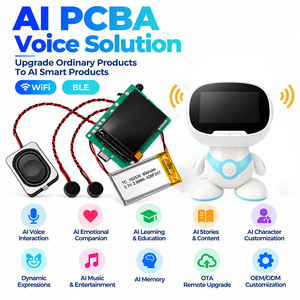
AISK AI Development Board for Educational Robot With Voice Interaction & Screen
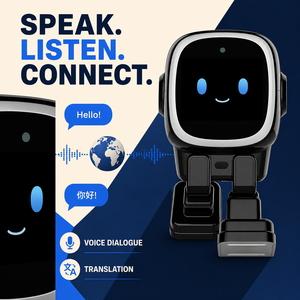
AI Emotional Companion Robot Touchscreen TFT Display Wi-Fi Voice Chat & Dancing
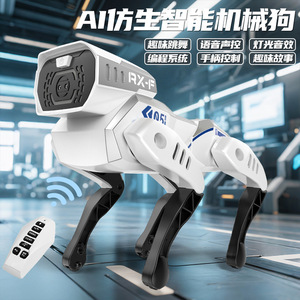
Interactive Smart Stunt RC Puppy Simulation Programmable Robot Dog Consumer
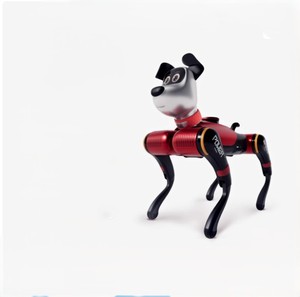
Weilan BabyAlpha A2 Dachshund Smart Programmable Dancing Robot Toy Sports

AI Smart Interactive Desk Robot Voice Control for Office Home Early Development
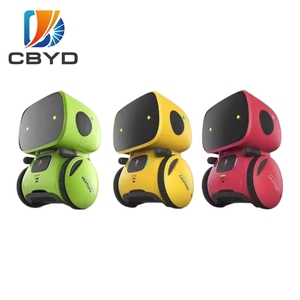
CBYD AI Educational Robot with OLED Display Wi-Fi Android 14 1080p Video Call
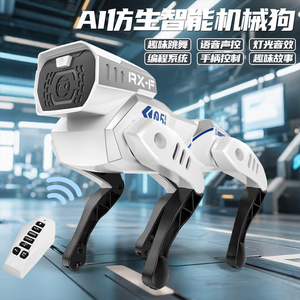
Children's Toys Water Bomb Eight-wheeled Robot Dog Gesture Sensor Climbing

DeepSeek AI Desktop Robot - 37 Languages Multilingual Companion Pet
The Paradigm Shift in San Francisco Bay Area Educational Robotics: Architectural Analysis & Sourcing Specifications
The San Francisco Bay Area—spanning Silicon Valley's tech corridor from San Jose and Santa Clara up through Palo Alto, Fremont, and the city of San Francisco—constitutes the world's most technically demanding market for programmable educational hardware. Buyers across Northern California no longer evaluate coding toys as passive consumer novelty items. Instead, the procurement criteria have firmly transitioned toward high-concurrency computational platforms, modular open-source architectures, and strictly compliant edge-AI devices capable of anchoring comprehensive Computer Science curricula aligned with California's K-12 Computer Science Standards.
As an engineering-driven manufacturer operated by Shenzhen Atp Intelligent Electronics Co., Ltd., we bridge the hardware-silicon valley divide. Our production ecosystems synthesize rapid hardware prototyping, precise micro-servo calibration, custom PCB surface-mount assembly, and certified COPPA/CCPA cloud firmware pipelines. This engineering document provides institutional purchasers, EdTech distributors, enterprise toy importers, and curriculum directors across the greater Bay Area with technical transparency into bill-of-materials (BOM) design, RF compliance, kinematics calibration, and direct container logistics through the Port of Oakland.
Localized Bay Area Use Cases: Bridging Visual Blocks to Autonomous Systems
Institutional procurement trends across San Francisco Unified School District (SFUSD), independent preparatory academies in San Mateo and Palo Alto, and specialized STEAM enrichment providers demonstrate distinct operational operational paradigms. Coding hardware must demonstrate tangible utility across multi-tier learning curves:
Silicon Valley K-12 STEM Academies
Utilizing products like our AISK AI Development Board and CBYD Android 14 Educational Robot to implement phased progression: students commence with Scratch/Blockly drag-and-drop algorithms to control sensor loops, progressing systematically to native MicroPython scripting for real-time edge vision and audio synthesis.
Palo Alto & Berkeley Maker Spaces
Robotics workshops leveraging our BabyAlpha A2 and Interactive Smart Stunt RC Puppy platforms to dissect inverse kinematics, multi-joint servo gear stress distributions, and closed-loop PID control algorithms, transitioning students from conceptual mechanical engineering to deployed edge robotics.
Public Library Coding Collectives
Deploying ruggedized Eight-Wheeled Robot Dogs and desktop companion units in drop-in communal tech labs. Hardware architectures feature high impact-resistance ABS casings, recessed optical lenses, thermal-cutoff LiPo battery containment, and zero-maintenance modular board swaps.
Silicon Valley Market Dynamics: The Intersection of LLMs, Edge AI, and Stricter Regulations
The convergence of generative artificial intelligence and robotics has fundamentally redefined expectations among parents, educators, and enterprise buyers in Northern California. Sourcing professionals must navigate three tectonic shifts currently reshaping the San Francisco educational toy market:
1. Edge Compute vs. Cloud Latency & Data Sovereign Privacy
Due to the aggressive enforcement of the California Consumer Privacy Act (CCPA) and California's Age-Appropriate Design Code Act, connected toys that transmit continuous ambient audio or unencrypted video streams to remote cloud servers face extreme regulatory pushback and potential institutional liability. Our technical answer lies in hybrid-edge computing. Utilizing specialized micro-NPUs, voice keyword detection (KWS) and fundamental natural language commands are processed 100% locally on our microcontrollers without triggering Wi-Fi uplinks. When cloud-based LLM integration (such as the DeepSeek Multilingual Companion platform) is engaged for comprehensive storytelling or multilingual code tutoring, voice data is buffered in volatile memory, encrypted via TLS 1.3, stripped of child-identifiable metadata, and never stored for model training.
2. Mechanical Durability in High-Throughput Classroom Environments
Typical retail robot toys are engineered for intermittent domestic play (under 15 duty hours per month). Educational institutions across San Francisco demand continuous multi-session operation. Our B2B manufacturing specifications mandate high-tensile metal-nylon hybrid gear trains within every joint servo, heat-dissipating aluminum motor plates, and stall-protection firmware logic that immediately de-energizes actuators when physical obstructions are encountered, preventing coil burnout and thermal casing deformation.
Comprehensive Technical Matrix: Educational Robotics Architecture for Institutional B2B Sourcing
The following engineering matrix outlines the technical specifications, microcontroller performance, safety certifications, and integration points for institutional buyers evaluating our product lines:
| Platform Category | Processor & NPU | Actuation & Mobility | Connectivity Protocol | Programming Framework | Safety & Compliance |
|---|---|---|---|---|---|
| AISK AI Dev Board | Dual-Core Xtensa 240MHz + 0.5 TOPS NPU | 4x PWM Servo Outs + Dual DC Motor Bridge | Wi-Fi 802.11 b/g/n + BLE 5.0 Mesh | Blockly, MicroPython, Embedded C/C++ | FCC Part 15B, CE, RoHS, Prop 65 |
| Bionic Quadruped (BabyAlpha/Stunt) | 32-bit ARM Cortex-M4 @ 168MHz | 8 to 12 Coreless High-Torque Servos | 2.4GHz Direct RF + BLE Realtime Telemetry | Kinematic Visual Scripter, Python CLI | ASTM F963-23, EN 71, IEC 62115 |
| Touchscreen AI Robot (CBYD) | Quad-Core 64-bit SoC @ 1.8GHz (Android 14) | Dual Continuous Brushless Drive Wheels | Dual-Band Wi-Fi (2.4/5GHz) + BT 5.2 | Android Studio SDK, Scratch 3.0 WebAPI | CCPA Child Privacy, COPPA, CE-RED |
| Multilingual Desktop AI | RISC-V High-Speed MCU + Dedicated Audio DSP | 3-Axis Head Kinematics + Expressive OLED | Secure Wi-Fi WPA3 Client + Offline Flash | Interactive Dialogue Builder, Node-RED | California Prop 65, FCC-ID, REACH |
Why San Francisco Importers & Brands Partner with Shenzhen Atp Intelligent Electronics
Sourcing directly from our state-of-the-art facility in Shenzhen, China gives San Francisco buyers a decisive competitive advantage in cost-to-performance ratio, time-to-market acceleration, and rigorous quality assurance:
Located at the epicenter of microelectronics, sound synthesis chips, precision brushless motors, and durable structural polymers. Component lead times are reduced by 40% compared to inland manufacturers.
We solve the classic engineering mismatch where plastic enclosures and electronics stifle plush or acoustic resonance. Internal acoustics, thermal baffles, and battery sleeves are designed concurrently.
From industrial CAD drafting and rapid SLA 3D printing to SMT circuit printing, custom mold cutting, and automated QA testing—our project engineers oversee your product lifecycle under one roof.
We perform pre-testing for California Proposition 65 (phthalates, lead), ASTM F963 mechanical hazards, small-part tests, drop/impact stress, and battery fire safety (UN38.3/IEC 62133) prior to shipment.
Procurement FAQ: San Francisco & Northern California B2B Sourcing Guide
Key operational questions addressed for purchasing managers, import compliance teams, and EdTech brand directors:
Architect Your Next-Generation Robotics Line with Our Engineering Team
Whether you require ready-to-ship ODM platforms for rapid retail launch across Northern California or complete ground-up OEM engineering with custom toolings, firmware, and curricula—Shenzhen Atp Intelligent Electronics delivers uncompromised manufacturing excellence.